
If you've spent any time in a running Facebook group or scrolled past a physical therapist's Instagram, you've seen the boots. Big, puffy, robotic-looking leg sleeves that inflate and deflate in waves while someone lies on their couch looking suspiciously relaxed for a Tuesday night. Normatec is the name that gets thrown around most, mostly because it's been in NBA locker rooms and marathon expos for over a decade. But when we actually priced out a pair, the number made us sit down. QUINEAR showed up in our research as the compression system that does almost everything Normatec does, at a fraction of the cost, and we wanted to know if that was too good to be true or just smart engineering catching up to an old category leader.
The short answer, if you don't want to read another 1,800 words about pneumatic sleeves: QUINEAR gets you the same core mechanism, sequential air compression that squeezes your calves and thighs in a wave pattern, for less than half of what Normatec charges. You give up a couple of premium extras, mainly app control and a battery pack on certain models, but you keep the part that actually matters, which is the compression itself. We'll walk through exactly where that gap shows up and where it doesn't, because "cheaper" only matters if the thing you're buying still does the job.
We're writing this as two everyday athletes, not lab techs. One of us runs 25 to 30 miles a week training for a fall half marathon. The other lifts four days a week and coaches rec-league basketball on the side, which means a lot of standing, a lot of stairs, and legs that feel like sandbags by Thursday. We tested the QUINEAR system over several weeks of real training blocks, and we cross-referenced it against Normatec's published specs, verified owner reviews, and secondhand accounts from a physical therapist friend who has both systems in her clinic. This isn't a sponsored comparison. QUINEAR is the product we link to below because it's the one we'd actually tell a friend to buy, and we'll explain exactly why.
| QUINEAR | Normatec | |
|---|---|---|
| Price (typical) | Premium | Premium investment range |
| Compression type | Sequential, zone-by-zone | Sequential, zone-by-zone (patented) |
| Pressure zones per boot | 4 zones | 5 to 7 zones (model dependent) |
| Pressure range | 0 to 150 mmHg, adjustable | 0 to 110 mmHg, adjustable |
| Power source | Plug-in with 6.5 ft cord | Rechargeable battery pack (higher-tier models) or plug-in |
| Portability | Compact controller, carry bag included | Bulkier pump unit, travel case sold separately on some models |
| App control | No app, physical remote | Bluetooth app on newer models |
| Warranty | 1-year limited warranty | 1-year limited warranty (standard), extended plans available |
| Boot weight (per leg) | Approx. 2.1 lbs | Approx. 2.6 to 3 lbs |
Where QUINEAR Wins
The obvious one is price. QUINEAR runs around $360 for the full system, boots, controller, and carry bag included. Normatec's entry-level line starts closer to $700 and climbs past $900 for the models with app control and the higher zone count. That's not a small gap. That's the difference between a purchase you make on a Tuesday because you're tired of sore calves, and a purchase you have to sleep on, run past a spouse, or wait for a Black Friday sale to justify. For most of the runners and lifters we know, dropping a grand on recovery gear when they're not being paid to train is a hard sell, no matter how good the boots feel.
The second win is pressure range. QUINEAR goes up to 150 mmHg, which is higher than what Normatec's consumer line offers. In practice, most people never crank it that high, especially in the first few sessions. But for the lifter of our two testers, who has thicker calves and a history of shin splints from years of playing pickup basketball on hardwood, having the headroom mattered. Lower-end compression on a bigger leg can feel like a light hug instead of an actual squeeze. QUINEAR let him dial up the intensity in a way that actually matched what his legs needed after a heavy squat day, without paying extra for a premium tier.
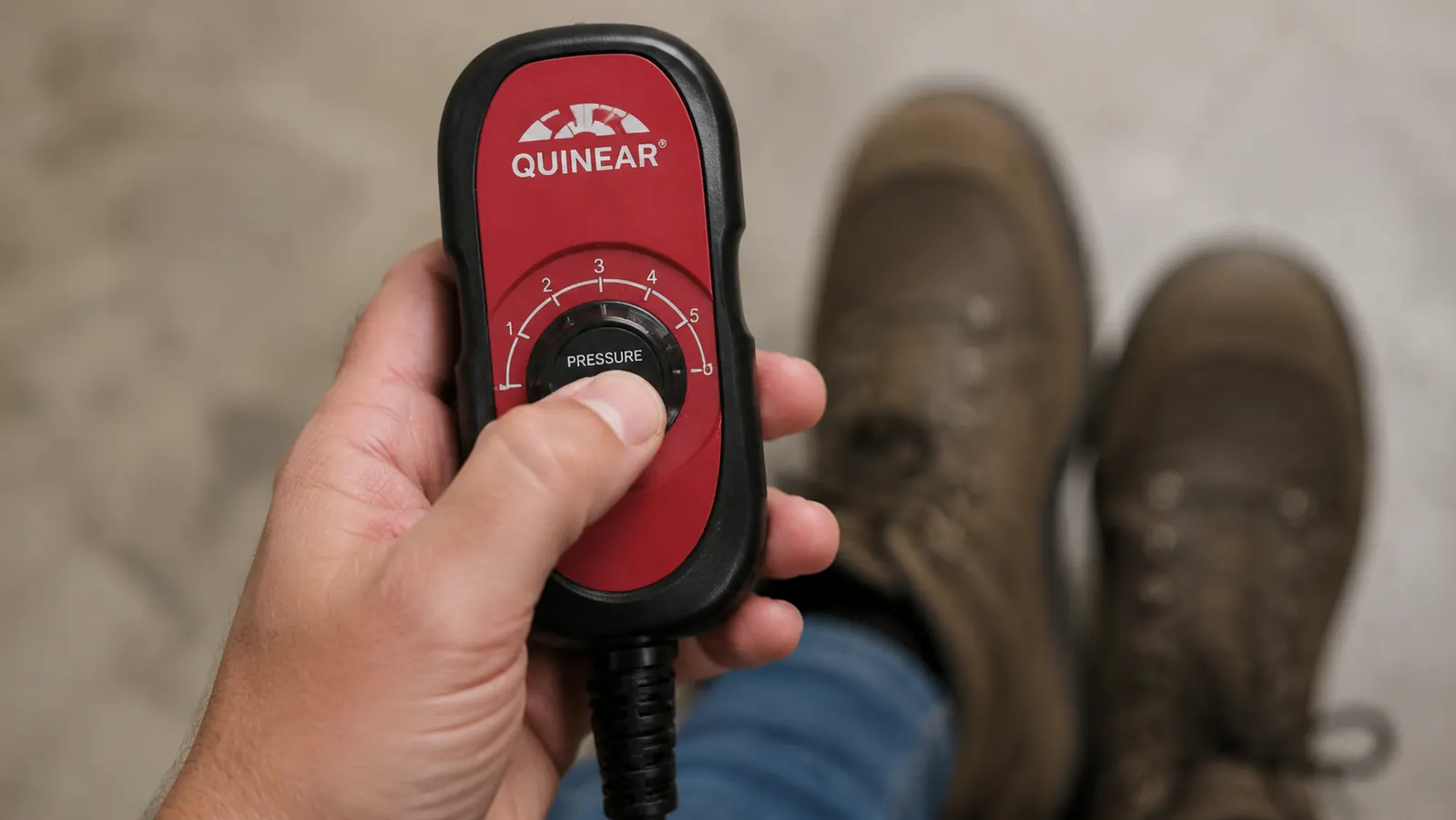
Third, and this is the one nobody talks about enough: the learning curve. QUINEAR's controller is a physical unit with buttons and a small screen. No app to download, no Bluetooth pairing that occasionally drops mid-session, no software update interrupting a 20-minute wind-down before bed. You plug it in, you zip into the boots, you press start. For the demographic actually buying compression boots, people in their late 30s through 50s who want relief, not another gadget to manage, that simplicity is worth real money even though it doesn't show up on a spec sheet.
There's also the first-use experience, which matters more than most comparison articles admit. Out of the box, the QUINEAR boots took about five minutes to figure out with zero manual reading required, mostly because the zipper and the strap layout are intuitive if you've ever worn a ski boot or a blood pressure cuff. The runner of our two testers used hers the same night it arrived, sitting through a full 20-minute session while catching up on a podcast. That kind of frictionless first impression matters, because recovery tools only work if you actually keep using them, and a complicated setup is exactly the kind of thing that gets a $700 pair of boots shoved in a closet by week three.
Get Normatec-style recovery without the Normatec-sized bill.
The QUINEAR Air Compression Recovery System delivers sequential zone compression up to 150 mmHg for less than half what the premium brands charge. See today's price and current availability on Amazon.
Amazon Check Today's Price on Amazon →
Where Normatec Wins
We're not going to pretend Normatec doesn't earn its reputation. The brand has been refining this technology since the early 2000s, and it shows in the small details. The zone count on their higher-end boots goes up to seven per leg, which allows for a more granular wave pattern as the compression moves from your foot up toward your hip. If you're the kind of athlete who notices the difference between a smooth, gradual pulse and a slightly choppier one, and some people genuinely do, Normatec's extra zones create a more refined sequence. It's a real difference, even if it's a subtle one for most casual users.
Normatec's app-connected models are also the more modern setup if you like tracking your recovery sessions the way you'd track a run on Strava. You can log sessions, adjust settings from your phone across the room, and some clinics use the app to build custom protocols for specific athletes. If you're working with a physical therapist or athletic trainer who wants to program your compression sessions the same way they'd program your lifts, that app integration has genuine value. It's the kind of feature that matters a lot to a small slice of serious athletes and matters basically nothing to someone who just wants their legs to feel less like bricks after leg day.
We asked ourselves a simple question: would the extra $400 make our legs recover any faster than the $360 boots. Neither of us could honestly say yes.
Battery-powered portability is Normatec's other edge. Some of their newer boots run on a battery pack, so you can use them on a plane, at a hotel, or courtside between games without hunting for an outlet. QUINEAR is plug-in only, which means you need to be near a wall socket, and that does limit where and when you can use it. If you travel constantly for races or tournaments and want compression therapy in a hotel room without fighting over the one outlet behind the nightstand, that's a legitimate reason to lean toward Normatec's battery models, even at the higher price.
Durability is the other place Normatec's reputation carries weight, and it's worth being honest about. A brand that's been in professional training rooms for years has a longer track record of holding up to daily, heavy-duty use across thousands of athletes. QUINEAR is newer to the market, and while our weeks of testing and the verified owner reviews we read showed no seam failures, weak zippers, or air leaks, we can't speak to what a boot looks like after three straight years of nightly use the way we can for a brand with over a decade of field data behind it. If you're buying for a training facility that runs boots on a dozen athletes a day, that history is worth factoring in.
Who Should Buy Which
If you're an everyday athlete, someone training for a race, lifting a few times a week, or dealing with legs that feel heavy after long shifts on your feet, QUINEAR is the more sensible buy. You get the core technology, sequential compression that mimics the muscle pump action your legs naturally use to move blood back toward your heart, at a price that doesn't require a financial gut check. We've used ours after long runs, after flights, and just on lazy Sunday evenings when our calves felt tight for no obvious reason, and the relief has been consistent every time. For the vast majority of people reading a comparison article like this one, that's exactly what you're shopping for.
If you're a competitive athlete with a training budget, someone working closely with a PT or trainer who wants app-based session tracking, or you travel constantly and need battery power away from an outlet, Normatec's higher-end line earns its price tag. It's a more refined tool built for people who are optimizing every variable in their recovery, not just trying to feel normal again after a hard week. There's no shame in either camp. It just depends on whether you're chasing marginal gains or chasing relief, and honestly, most of us bought these boots because our legs hurt, not because we're chasing a podium finish.
One more thing worth saying plainly. A lot of the Normatec name recognition comes from seeing it on professional sidelines, and that association makes it feel like the "real" version and everything else a knockoff. But sequential pneumatic compression isn't proprietary magic. The core mechanism, inflatable chambers that squeeze in a wave pattern from foot to thigh, is well understood technology at this point, and several brands including QUINEAR have built solid, reliable versions of it. You're not settling for a lesser experience by choosing the more affordable option. You're paying for the brand story and a handful of extra features you may never use.
We'll also say this because it matters more than either of us expected going in. The sessions themselves, the actual 15 to 20 minutes of sitting with your legs squeezed and released in waves, felt basically identical between the two systems in every way that counts. Same building pressure starting at the foot, same release as it climbs toward the thigh, same loose, drained feeling in your calves when you unzip the boots afterward. If someone put us in a blind test with a towel over the control units, we're not confident either of us could tell you which brand we were wearing.
Ready to stop guessing and just recover faster?
The QUINEAR Air Compression Recovery System gives you sequential compression, adjustable pressure up to 150 mmHg, and a simple plug-in setup, all for less than half the cost of premium alternatives. Check current pricing and availability on Amazon before you decide.
Amazon Check Today's Price on Amazon →