
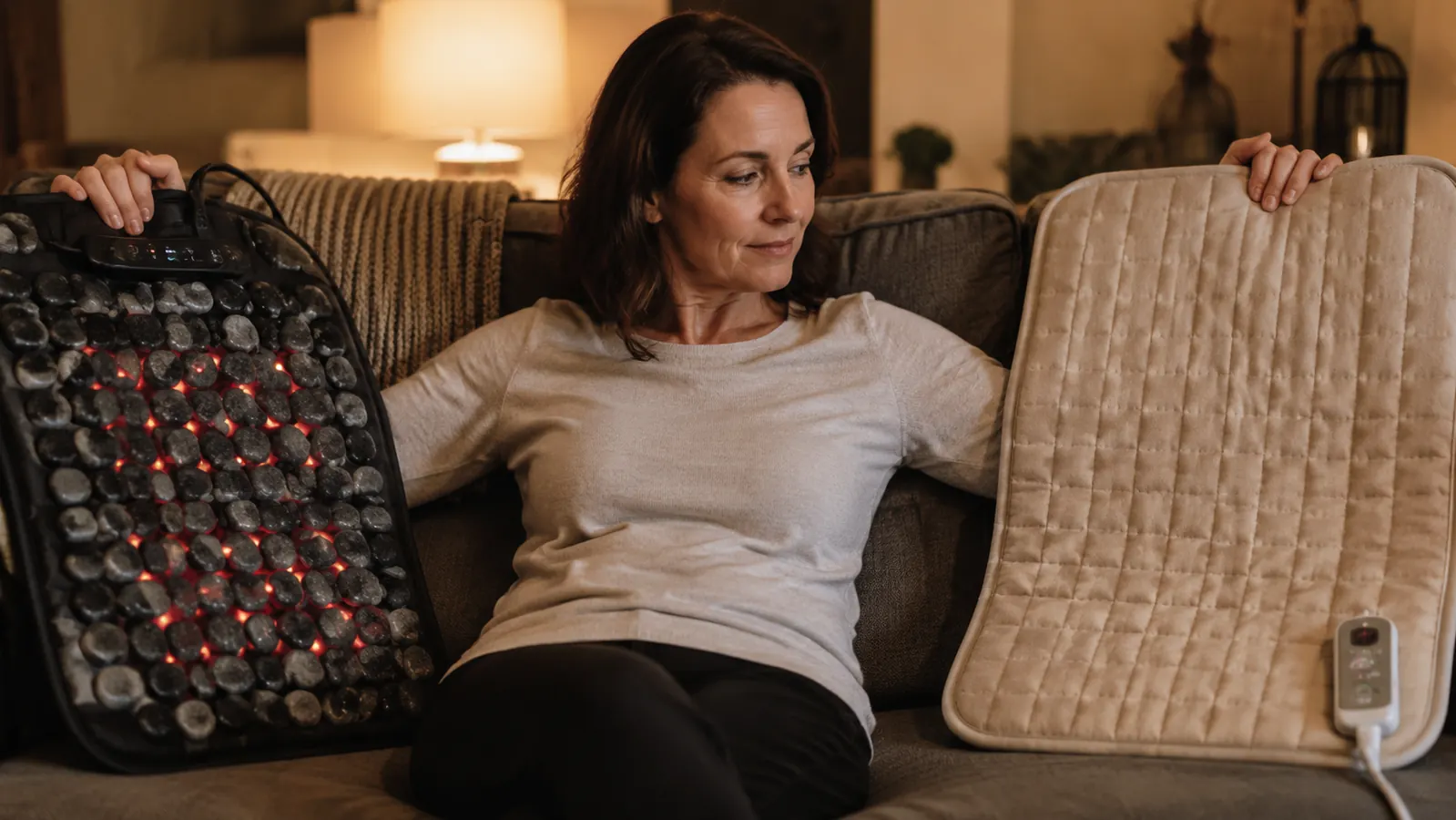
We've owned both. For years it was one of those thin electric heating pads from the drugstore, the kind with a controller clipped to the cord and a low-medium-high dial that never quite told you what temperature you were actually getting. Then we spent about six weeks testing the UTK Far Infrared Heating Pad against it, swapping back and forth on the same bad days, same stiff mornings, same nights after a long drive home from a weekend tournament. The short answer is that they are not really doing the same job, even though they look like they should be interchangeable when you see them side by side in a product listing. One heats your skin. The other heats past it.
This comparison is not about which pad is cheaper or which one has more five-star reviews stacked up on Amazon. It's about what actually happens when you put one against a sore lower back for twenty minutes, and what happens the other nineteen days out of the month when you're not using it at all, just deciding whether it's worth pulling out of the closet again.
Quick answer if you're short on time: if the pain is deep, chronic, or shows up in the same spot week after week, the UTK infrared pad is the one that's built to actually change how that tissue feels. If it's occasional surface soreness you want to knock out for twenty minutes before bed, a standard electric pad still gets the job done and costs a fraction as much. The rest of this breaks down exactly why, spec by spec, so you're not guessing.
| UTK Infrared | Regular Electric Heating Pad | |
|---|---|---|
| Heat type | Far infrared (radiant heat via natural stones) | Surface conduction (resistive wire coil) |
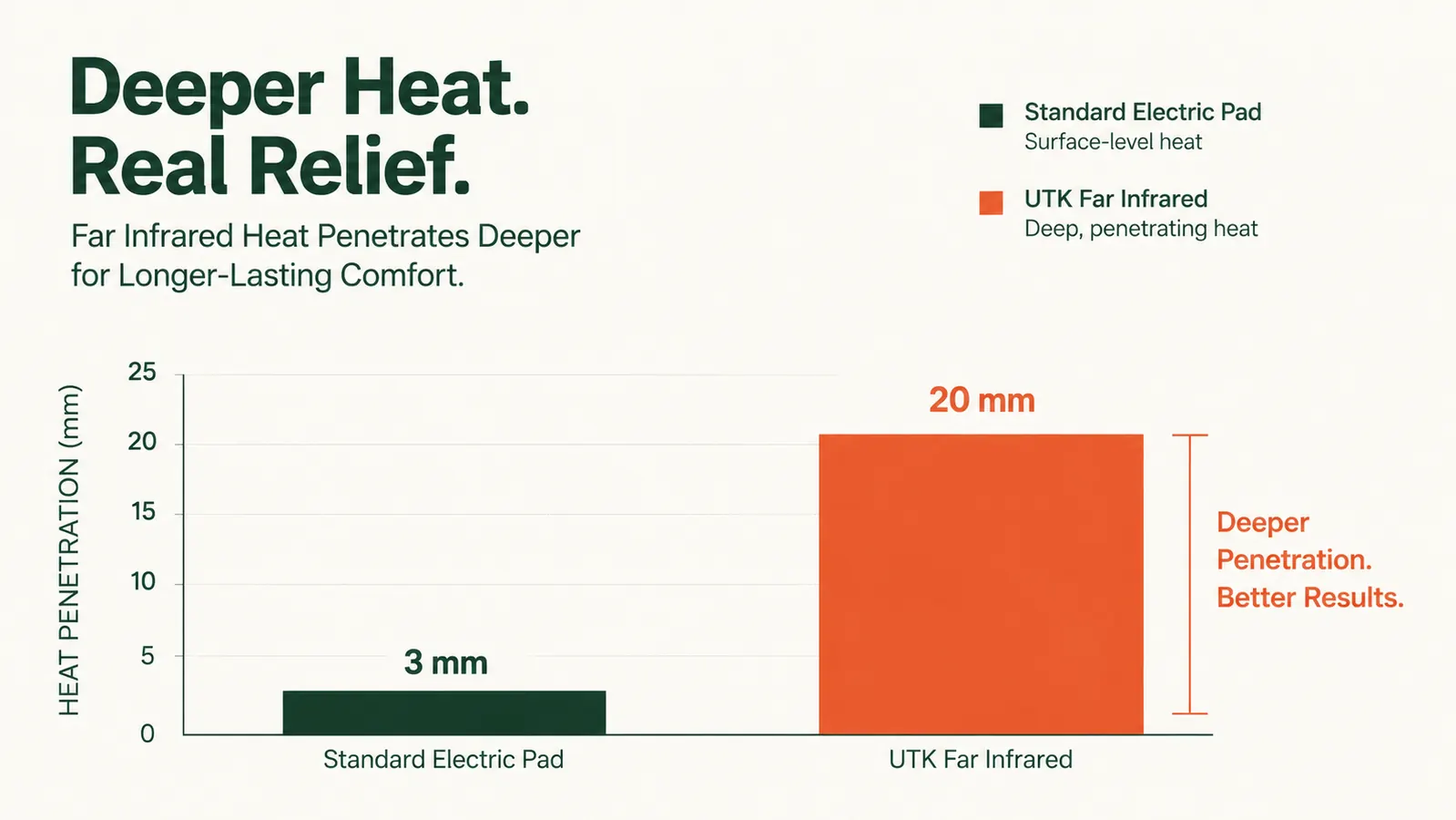
| Penetration depth | Up to 1.5 to 2 inches into muscle tissue | Skin surface and shallow subcutaneous layer only |
| Heating element | Amethyst, tourmaline, and jade stone pack | Woven electrical coil or carbon fiber wire |
| Temperature range | 95F to 158F, adjustable in small increments | Typically 3 fixed settings, low/medium/high |
| Auto shut-off | Yes, programmable up to several hours | Usually 2-hour auto-off, non-adjustable |
| Size and coverage | Large, roughly 33 x 17 inches, wraps the full lower back | Small to medium, 12 x 15 inches average, spot coverage only |
| EMF exposure | Low EMF design, shielded wiring | Standard EMF from coil wiring, unshielded on most budget models |
| Current price | Check today's price on Amazon | Budget-friendly at drugstores or big-box retailers |
| Best for | Chronic stiffness, deep muscle knots, daily desk-job pain | Occasional mild soreness, quick surface warmth |
Look at that penetration depth row again, because it's the whole story and everything else in this comparison branches off of it. A regular electric heating pad warms your skin and the layer just under it. That's it, that's the ceiling. It feels good for the first five minutes because heat on skin is genuinely soothing, our brains are wired to like it, but if the ache is coming from a knot in your erector spinae or a tight piriformis sitting an inch and a half under the surface, the heat from a standard pad mostly just sits on top of it like a warm towel resting on a problem it can't reach. The UTK pad uses far infrared wavelengths generated by the stone layer inside it, amethyst, tourmaline, and jade specifically, which pass through skin and reach into the muscle itself instead of stopping at it. You feel it as a deeper, almost thicker warmth instead of a thin surface glow that fades the moment you unplug it.
Where the UTK Infrared Pad Wins
The biggest win is depth, and depth is the whole reason infrared exists as a heat therapy category in the first place. We noticed it most on mornings after deadlift day, when the soreness sits low and deep rather than sitting on the skin where you can just rub it. A standard electric pad on those mornings felt like putting a warm towel over the problem and hoping it worked its way down. The UTK pad felt like it was actually reaching the tight spot within a few minutes, not just warming the air between the pad and the muscle. That's not us being dramatic about a heating pad, it's just what radiant heat does differently than conductive heat, and it's the same underlying physics behind why infrared saunas get used for muscle recovery instead of someone just aiming a space heater at your back for twenty minutes.
The second win is coverage and control, and this one matters more than people expect until they're actually lying on the thing. At roughly 33 by 17 inches, the UTK pad wraps the entire lower back and part of the hips in one placement, no repositioning required halfway through. A standard 12x15 pad covers one spot, so if your soreness spans from the lower back into a hip, which it usually does after a long run or a heavy squat session, you're either repositioning it every few minutes or buying a second pad just to cover the whole area. The UTK also gives you real temperature granularity, 95F up through 158F in small steps, instead of three vague settings that don't tell you an actual number and make it hard to be consistent day to day. On a stiff Tuesday morning we want it around 130F. On a lazy Sunday recovery day we want it closer to 110F for a longer, gentler session while reading or watching film. A dial that just says low, medium, high doesn't let you dial any of that in with any precision.
Auto shut-off is the other quiet advantage that only shows up after you've owned the thing for a few weeks. Most drugstore pads cap out at a fixed 2-hour shutoff you can't change no matter what you do, which is fine until you fall asleep on the couch at hour one and wake up cold two hours later with the pad long since shut off and the ache back. The UTK lets you set the session length yourself, so a 45-minute session actually runs 45 minutes instead of getting cut short or running the full two hours regardless of what you actually wanted that day.
Heat that reaches the muscle, not just the skin
If your soreness sits deep and a regular pad never quite gets there, the UTK Far Infrared Heating Pad is built to go past the surface. Check today's price and see the current deal on Amazon.
Amazon Check Today's Price on Amazon →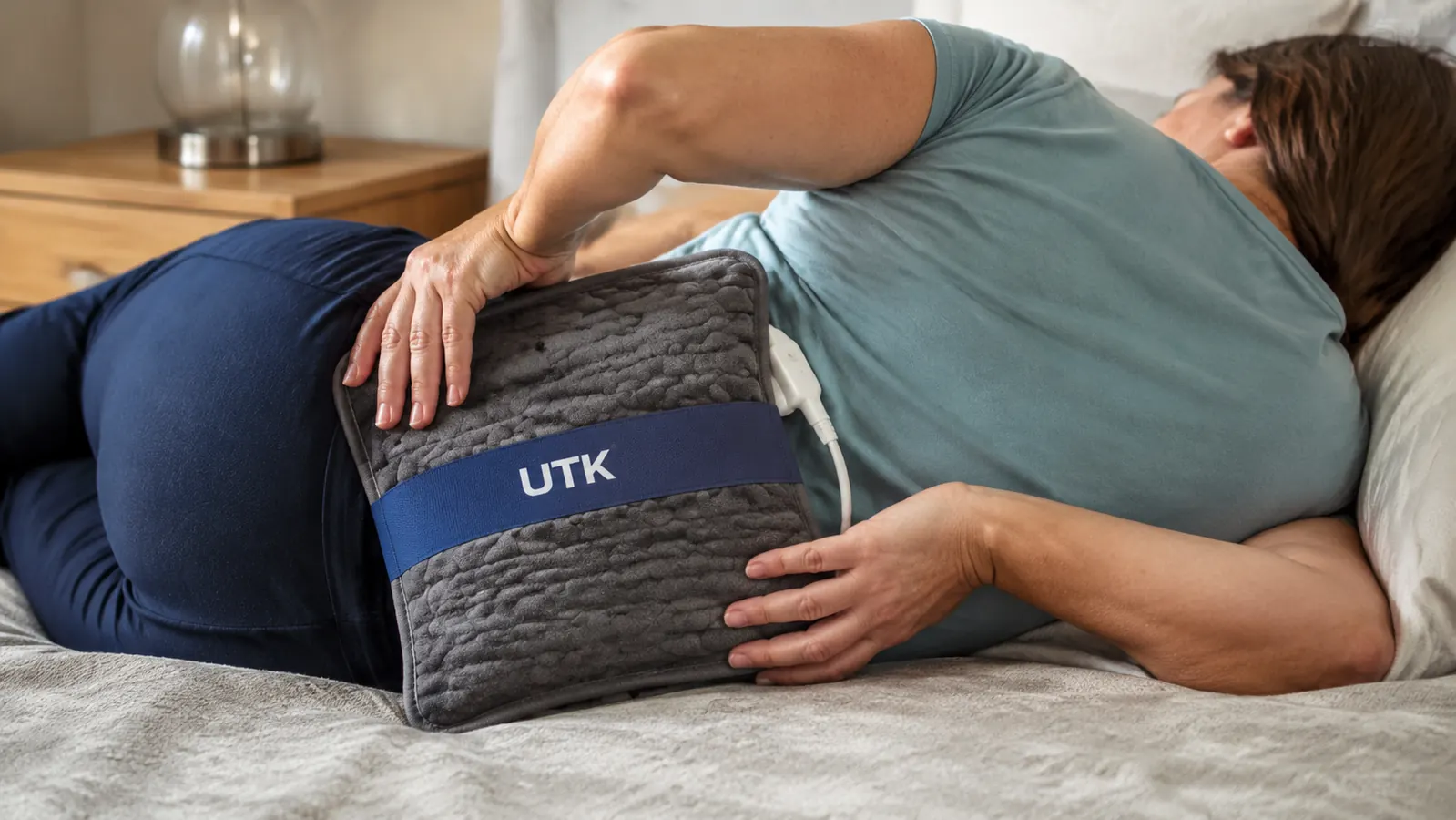
Where a Standard Electric Heating Pad Wins
We're not going to pretend the standard pad has nothing going for it, because it does, and pretending otherwise would be dishonest. The upfront cost is the obvious one. A basic electric pad runs budget-friendly at nearly any drugstore or big-box store, sometimes less if it's on sale, and for someone who just wants occasional warmth on a stiff neck once or twice a month, that's a completely reasonable purchase that doesn't need to be overthought. You don't need deep tissue penetration for a mild ache that clears up on its own by dinner without any help at all.
It's also lighter and more flexible for small, awkward spots that a bigger pad just doesn't sit well against. A standard pad drapes easily around a shoulder or wraps a wrist in a way the larger, stiffer UTK pad isn't really designed to do, since the stone layer inside it doesn't bend the same way soft quilted fabric does. If your pain is more "crick in the neck from sleeping wrong" than "chronic lower back tightness from sitting eight hours a day," the smaller pad is honestly easier to position and doesn't require finding a spot to lie flat for twenty minutes. It also heats up faster since there's less mass to warm, so if you want two minutes of surface warmth before running out the door to pick up the kids, it gets there quicker than a stone pack ever will.
The EMF and Safety Difference
This one doesn't get talked about enough in most comparisons, and it should. Standard electric heating pads run current through a resistive wire coil, and that coil generates electromagnetic field exposure the entire time it's plugged in and heating, sitting a few inches from your skin. For occasional short use, most people don't think twice about it, and honestly they probably don't need to. But if you're someone who falls asleep with a heating pad running most nights, like we did for a stretch after a bad lower back flare-up two winters ago that made sleeping without heat almost impossible, that's hours of nightly EMF exposure against your skin, night after night, for weeks at a time. The UTK pad is built with shielded wiring specifically to reduce that exposure, which matters more the more often you're actually using the thing rather than reaching for it twice a month. If you're an occasional user this is a minor footnote you can safely ignore. If you're a nightly user, or close to it, it's worth actually factoring into the decision instead of skipping past it.

Who Should Buy Which
If your pain is chronic, sits deep, or shows up in the same spot week after week, whether that's a lower back that never fully loosens up after a desk job or a hip that flares every time you sit in the car too long on a road trip, the UTK infrared pad is the one built for that specific job. The extra size, the real temperature control, and the actual muscle-level penetration all add up over repeated use in a way a budget pad simply can't match, even if the budget pad looks similar sitting next to it in a product photo. We'd also point it at anyone who already foam rolls or stretches regularly and wants the heat to actually soften the tissue beforehand instead of just warming the skin on top of it before they get to work.
If you're dealing with occasional, mild soreness, a stiff neck once in a while, a sore shoulder after a weekend of yard work, and you don't want to spend more than the cost of a decent lunch, the standard electric pad still does a real job and there's no shame in sticking with it. It's not useless, it's just built for a shallower, shorter-term problem than what most of our regular readers are actually dealing with day in and day out.
There's also a middle ground worth naming honestly. If you already own a standard electric pad and it's doing an adequate job on the occasional flare-up, you don't need to throw it out. What we did for a while was keep the small pad in a desk drawer at work for quick relief between meetings, and kept the UTK pad at home for the real recovery sessions after training. They're not mutually exclusive, they just solve different problems, and buying the bigger pad doesn't mean the small one becomes useless overnight.
For deep, recurring soreness, surface heat isn't enough
See why the UTK Far Infrared Heating Pad is the one we reach for on the days regular heat doesn't cut it. Check today's price on Amazon.
Amazon Check Today's Price on Amazon →