
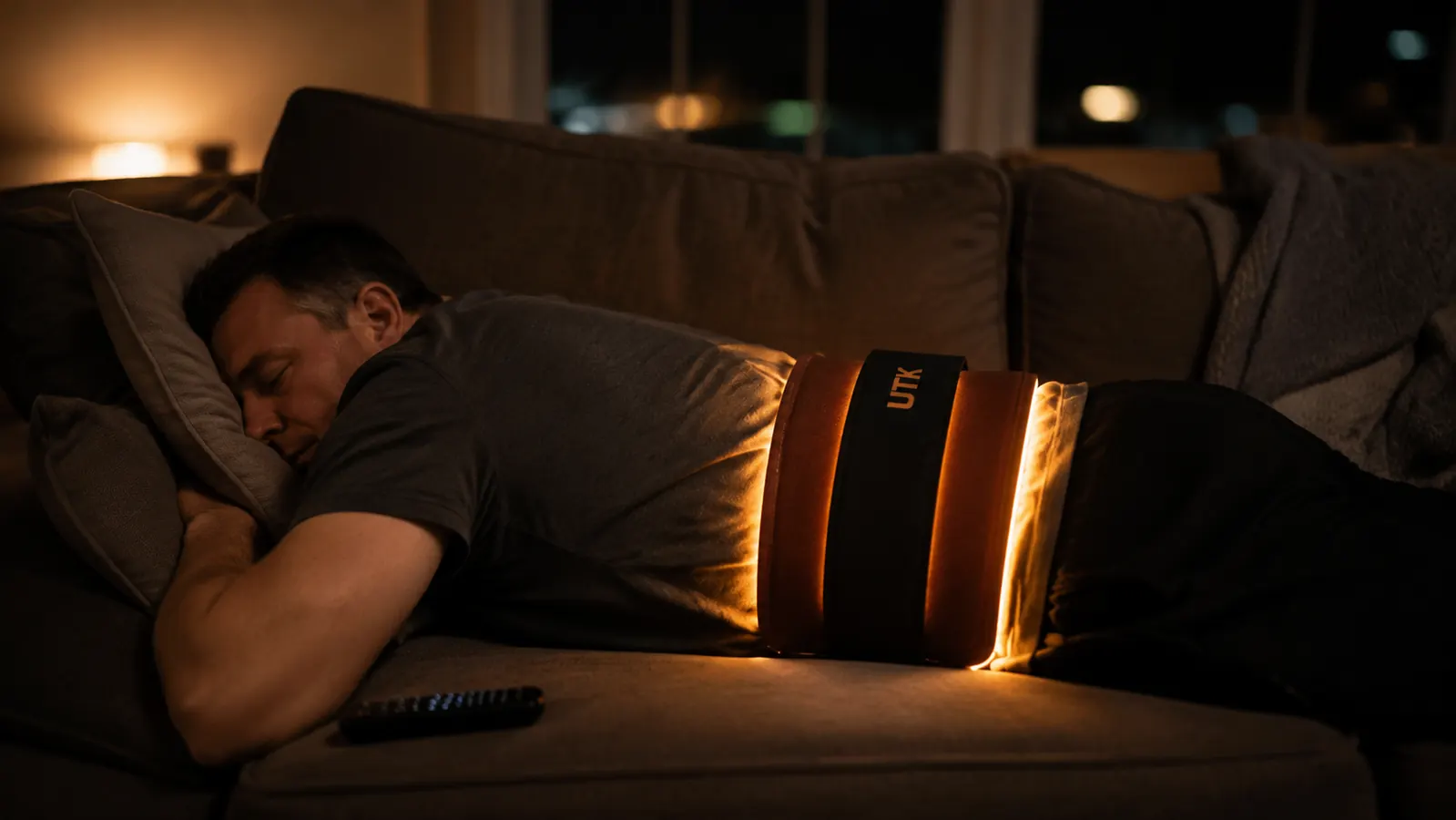
I bought the UTK far infrared heating pad in early January because my lower back had gotten to the point where I was popping ibuprofen before bed just to sleep flat. I'm 44, I lift four days a week, and I sit at a desk the other three managing a warehouse crew. Somewhere between the deadlifts and the desk chair, my L4-L5 area turned into a low, dull ache that never fully went away. A regular electric heating pad from the drugstore helped for maybe twenty minutes, then the heat faded and the ache came right back. I'd seen the UTK pad mentioned in a few lifting forums as something that actually holds heat longer because of the jade and tourmaline stones sewn into it, so I ordered the standard back-and-lower-body size and told myself I'd give it six months before writing anything about it.
Six months later, I've used it somewhere between 140 and 150 nights. Not every single night, but close. This is what actually happened, good and bad, no rounding up.
The Quick Verdict
The deepest, longest-lasting heat I've tried for chronic lower back tightness, worth the higher price if you actually use it nightly, but it's bulky and the cord placement takes some getting used to.
Amazon Check Today's Price →Still icing your back at 11pm hoping it works this time?
If a drugstore heating pad cools off before your muscles ever loosen, you're not getting real relief, you're getting warm for twenty minutes. The UTK pad's stone grid holds infrared heat deep enough to actually change how your back feels the next morning.
Amazon Check Today's Price on Amazon →How I've Used It
My routine is boring and consistent, which is exactly why it's a fair test. Most nights around 9pm, after the dishes are done, I lie face down on the couch or in bed, drape the pad across my lower back, and set the controller to medium, which on this pad runs around 131°F at the stone surface. I run it for 30 to 45 minutes while I scroll my phone or half-watch whatever my wife has on. On heavier training days, usually after squats or deadlifts, I'll bump it to high for the first ten minutes then dial back down.
I also started using it on my left shoulder about two months in, after a rough week of overhead pressing left it tight and clicky. The pad is really built for a torso or back, so draping it over a shoulder means it doesn't sit flush, but I found a way to fold it so the stone panel covers the front delt and upper trap at the same time.
The auto shut-off is set at 20 minutes by default unless you change it, and I appreciated that the first few weeks when I fell asleep with it on twice. After that I started manually setting it to 45 minutes so it wouldn't cut off mid-session.
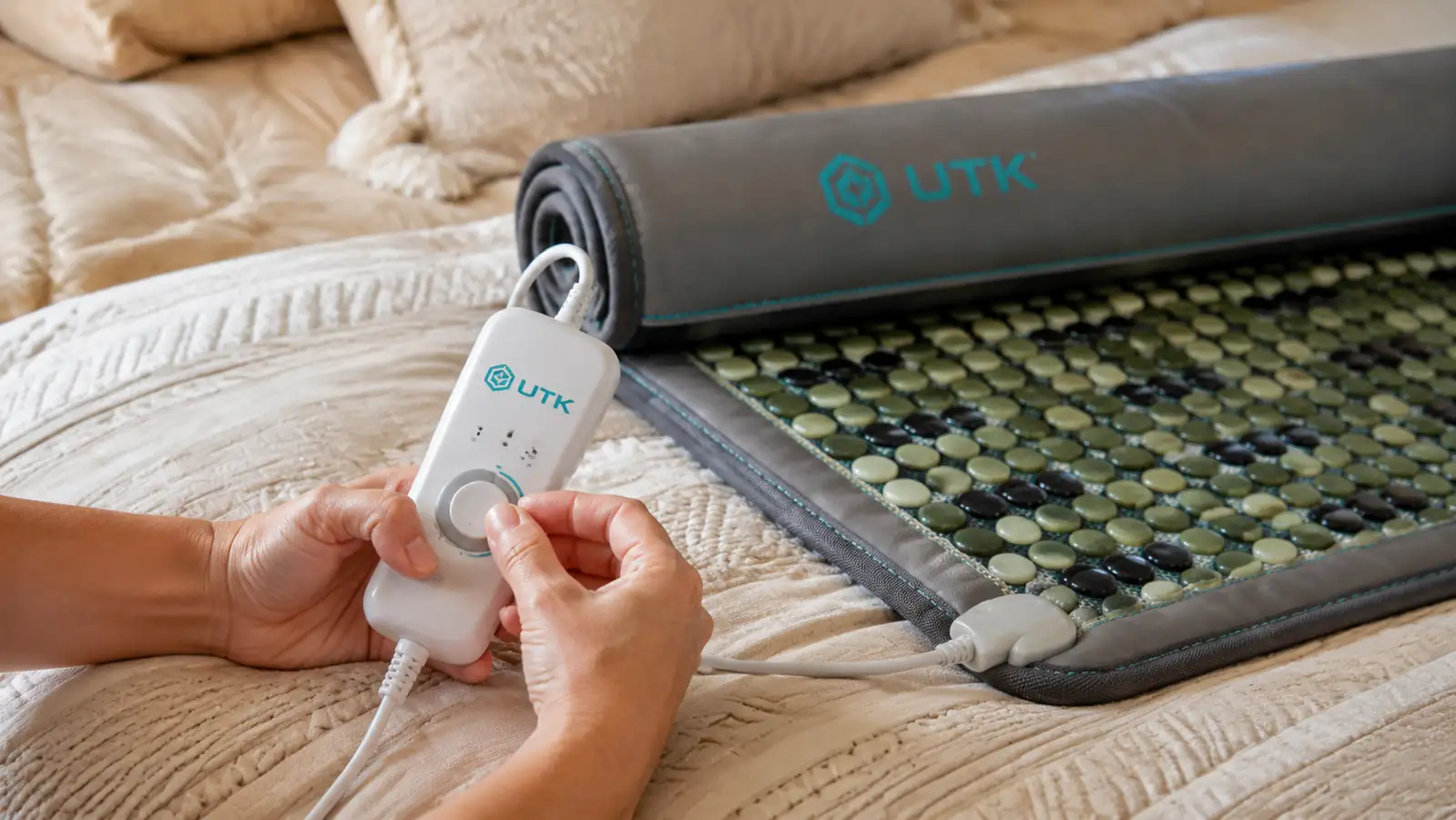
Setup itself is simple enough that I never needed the manual after the first night. The pad plugs into a corded controller with a rotary dial for temperature and a small display for the timer, no app, no Bluetooth, nothing that can lose a firmware update six months in. For someone who's tired of every recovery gadget wanting a phone pairing, that plain simplicity is part of why I still reach for it instead of letting it collect dust like my old massage gun app did.
What the Jade and Tourmaline Actually Do
I was skeptical of the stone angle at first. It sounds like marketing dressed up as science. But the mechanism is straightforward once you look past the branding, jade and tourmaline are just dense, heat-retentive minerals that the pad's internal heating elements warm up, and those stones then radiate far infrared heat back into your skin more evenly and for longer than a bare wire or gel element would. It's not magic, it's thermal mass. A regular electric pad heats the fabric directly and loses heat fast the moment it's not touching skin. This one keeps radiating for a couple minutes after I take it off, which a cheap pad from the pharmacy never did.
The practical difference I noticed over the first month was depth. A standard heating pad warms the skin and maybe the first half inch of tissue. This one, especially on high, gets warm enough that I feel it in the actual muscle belly, not just on the surface. That matters for something like my lower back where the tightness sits in the erector spinae, not just the skin.
Six Months of Actual Back Pain Data
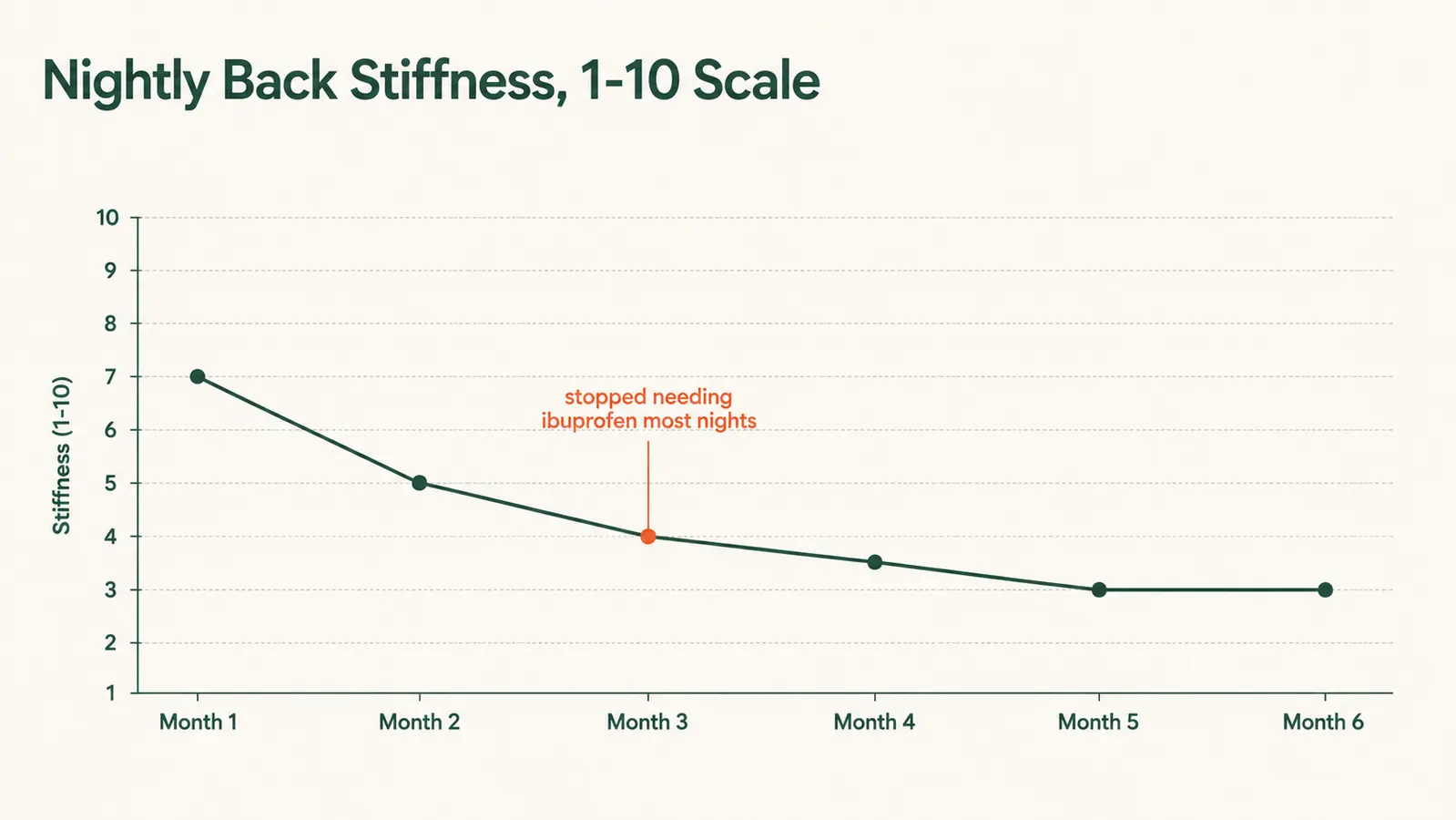
I started tracking my morning stiffness on a simple 1 to 10 scale in the Notes app back in January, mostly out of curiosity, not because I planned to write about it. Month one I was averaging a 7, stiff enough that I needed to stretch for ten minutes before I felt normal getting out of bed. By month three that average dropped to around 4-5, and that's roughly when I noticed I'd stopped reaching for ibuprofen most nights. By month six I'm sitting around a 3, with occasional spikes back to 5 or 6 after a brutal leg day or a long drive.
I'm not claiming the heating pad fixed my back. I also started doing more deliberate hip mobility work around month two, and I dropped my squat depth slightly on heavy days, which probably helped too. But the nightly heat sessions are the one variable that stayed constant the entire six months, and the stiffness curve tracks closely with when I started being consistent about using it.
What I Considered Instead
Before I settled on the UTK pad, I looked at three other options. A basic Sunbeam electric heating pad I already owned, a microwaveable rice bag my mother-in-law swears by, and a cheaper bargain-brand infrared pad on Amazon that had similar marketing language but a fraction of the reviews. The Sunbeam was fine for a quick warm-up before stretching, but it never held enough heat to matter once I was actually lying still for thirty minutes. The rice bag has its place, honestly it's still what I grab for a quick five-minute warm-up before squats, but it cools within ten minutes and reheating it every night in the microwave got old fast.
The bargain infrared pad worried me because the stone coverage looked sparse in the product photos compared to UTK's, like a handful of stones glued in rows rather than a dense grid. I didn't buy it to compare directly, but two lifting buddies who did told me theirs ran hot in some spots and barely warm in others within four months. That kind of inconsistency defeats the whole point of an infrared pad, so I paid more for UTK on the theory that even stone distribution mattered more than saving money. Six months in, I still think that was the right call. I haven't found a single cold spot on mine.
Who This Pad Is Actually Built For
This is not a pad for someone who wants to throw it on for five minutes before bed and call it done. The stones take a few minutes to fully heat up, and the real benefit shows up after 20-30 minutes of contact, not immediately. If you're the type who wants instant heat the second you flip the switch, a cheap electric pad will scratch that itch faster, even if it doesn't go as deep.
It's also genuinely heavy. The stones add real weight, somewhere around 6 pounds for the full-size back version, which is part of why the heat penetrates so well but also means it's not something you're tossing in a gym bag or travel carry-on without thinking about it. I keep mine folded on a shelf next to the couch because moving it around the house daily got annoying by week three.
What I Liked
- Heat penetrates noticeably deeper than a standard electric pad, felt in the muscle not just the skin
- Holds warmth longer after shutoff thanks to the stone thermal mass
- Auto shut-off timer is adjustable and genuinely useful for fall-asleep nights
- Controller has enough temperature granularity to dial in exactly what a given night needs
- Held up structurally after 150+ uses, no dead spots or uneven heating so far
Where It Falls Short
- Heavy and bulky, not something you casually move room to room
- Takes 5-10 minutes to reach full depth of heat, not an instant-relief tool
- Cord and controller placement can get in the way when lying on your stomach
- Price is noticeably higher than a standard drugstore heating pad
- Doesn't contour well to shoulders or smaller joints, it's built for flat torso/back use
It's not a pad you use for five minutes and forget. It's a pad you build a routine around, and the routine is where the relief actually comes from.

Where It Falls Short
The cord is my one recurring annoyance. The controller sits at the end of a fairly short cord, and when I'm lying face down with the pad across my back, the controller ends up somewhere near my hip where I have to fumble for it if I want to adjust the temperature mid-session. It's a small thing, but after 150 nights it's the one design choice I'd change.
I also wish the auto shut-off had a longer maximum setting. Mine tops out around 45 minutes to an hour depending on the version, and on my worst nights I sometimes want it running longer than that while I sleep, though the manufacturer's own safety guidance is clear that longer isn't really recommended anyway.
The other thing worth mentioning is noise, or the lack of it. There's a faint hum from the controller when it first kicks on, barely audible over a quiet TV, and it goes silent once the target temperature is reached and the element cycles into maintenance mode. It's not something I noticed until my wife pointed it out during a movie in month two, and it hasn't bothered either of us since.
Cost-per-use is where this pad actually wins the argument for me. At roughly 150 nights of use over six months, I'm well under a dollar a session even before counting the months I'll keep using it going forward. Compare that to a heating pad that dies after a year of daily use, or to the cost of a single deep tissue massage, and the math stops feeling like a splurge pretty quickly.
Who This Is For
If you've got a chronic, low-grade ache, the kind that comes from years of desk work stacked on top of training rather than one acute injury, this pad earns its place in a nightly routine. It's especially good for lower back, hips, and general torso tightness where you want broad, even, deep heat rather than a targeted spot treatment. Desk workers who train after hours, like me, are probably the ideal user. You get home stiff from sitting, you train, and then you need something that undoes both problems at once.
Who Should Skip It
If you're dealing with an acute injury, a fresh strain, or anything a doctor should actually look at, heat isn't always the right first move and you should get that checked before adding any heating pad to the mix. And if you just want quick, casual warmth for the odd sore night, the price and bulk here are hard to justify over a basic pad you can toss in a drawer. This is a tool for people who know they'll use it several nights a week for months, not an occasional comfort item.
Six months of nightly heat changed my mornings. Yours could start tonight.
I wish I'd bought this the first month my back started acting up instead of the third year. If your evenings look like mine did in December, stiff, achy, reaching for pills that only half work, this is worth the shelf space.
Amazon Check Today's Price on Amazon →