
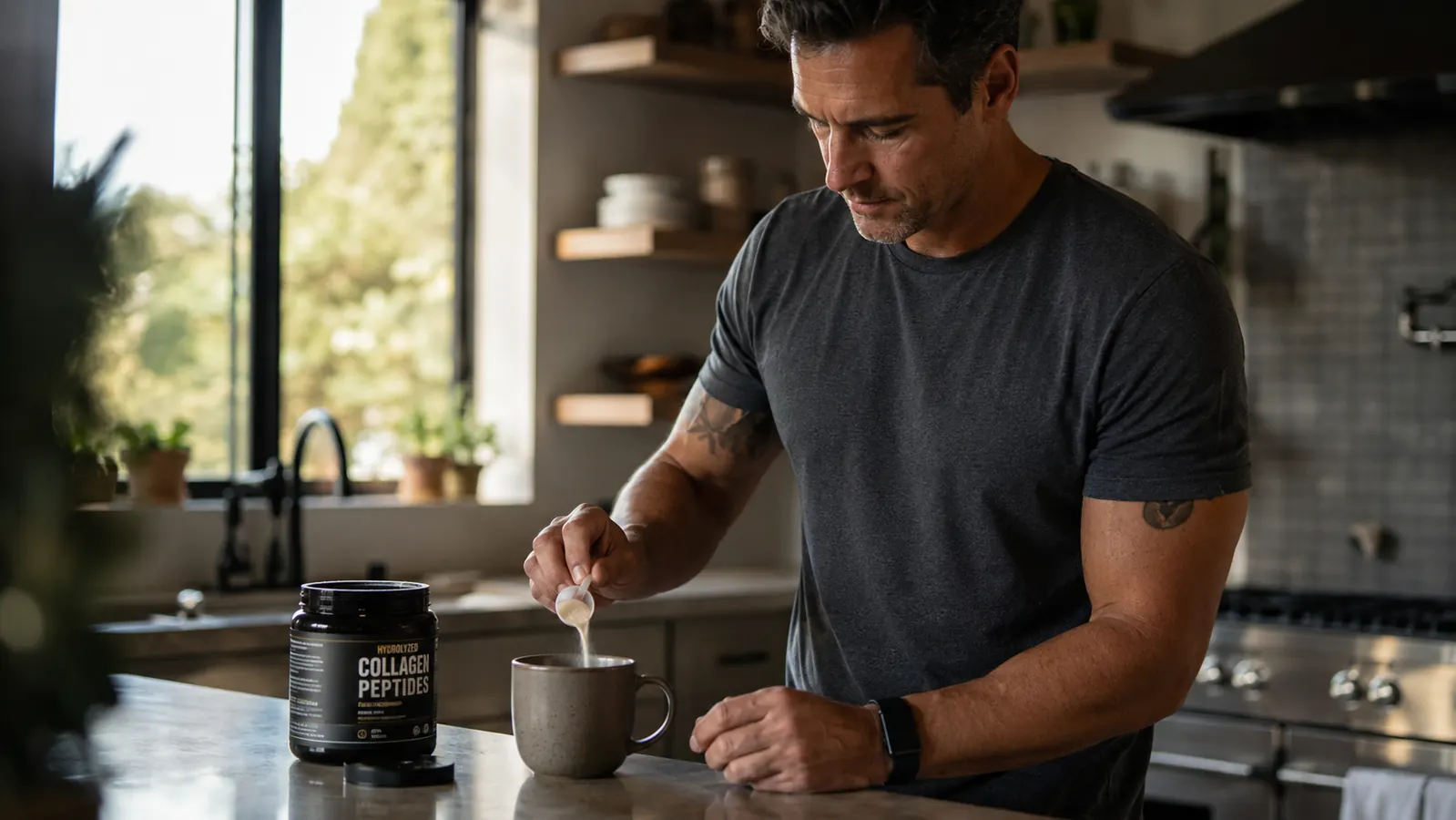
I started taking Sports Research Collagen Peptides back in January, mostly because my right knee had gotten to the point where I noticed it before I even got out of bed. Not sharp pain, just a stiff, creaky feeling that took the first ten minutes of my morning to shake off. I'm 43, I've been lifting and running on and off for over two decades, and that knee has taken a beating from years of squats, deadlifts, and 5Ks on pavement. Six months later, the tub is still sitting next to my coffee maker, because I still use it almost every single morning.
This isn't a review of the Sports Research collagen based on two weeks and a hopeful feeling. I've used this through a winter strength block, a spring half-marathon training cycle, and a stretch in June where I was traveling for work and still packed the tub in my suitcase rather than skip it. I'm not a physical therapist and I'm not going to tell you collagen rebuilt my cartilage. What I can tell you is what changed in my own body over six months of daily use, and where I think the marketing gets ahead of the actual science.
The Quick Verdict
A genuinely flavorless, easy-to-mix collagen that I've stuck with for six months, with a noticeable but gradual improvement in morning knee stiffness. Loses half a point because results took nearly two months to show up, not two weeks.
Amazon Check Today's Price →Stiff knees before you even get out of bed? Here's what I changed first.
I was skeptical a flavorless powder could do anything for a knee that's been cranky since my 30s. Six months in, my mornings look different. Check today's price and see if it's in stock.
Amazon Check Today's Price on Amazon →How I've Actually Used It
My routine hasn't changed much since week one. Every morning, I scoop about 20 grams of the Sports Research collagen, two heaping scoops, into my coffee before I add cream. On heavier training days, squats or deadlifts, I'll sometimes stir a second scoop into a post-workout shake along with my whey. That's it. No cycling on and off, no skipping weekends, just a flavorless powder in my coffee cup roughly 180 mornings in a row since late January.
I didn't change anything else about my routine on purpose. Same lifting split, same running mileage, same mattress, same standing desk setup at work. I wanted this to be as close to a controlled test as one guy in his kitchen can run, because collagen supplements get a lot of hype online and I wanted to know if the hype held up for me specifically, not for some study participant I'll never meet.
It has held up, with a caveat I'll get into below about timeline. The bigger surprise was how little friction it added to my morning. I expected to get tired of an extra step in my routine. Six months in, it's as automatic as brushing my teeth.
Taste and Mixability, Day to Day
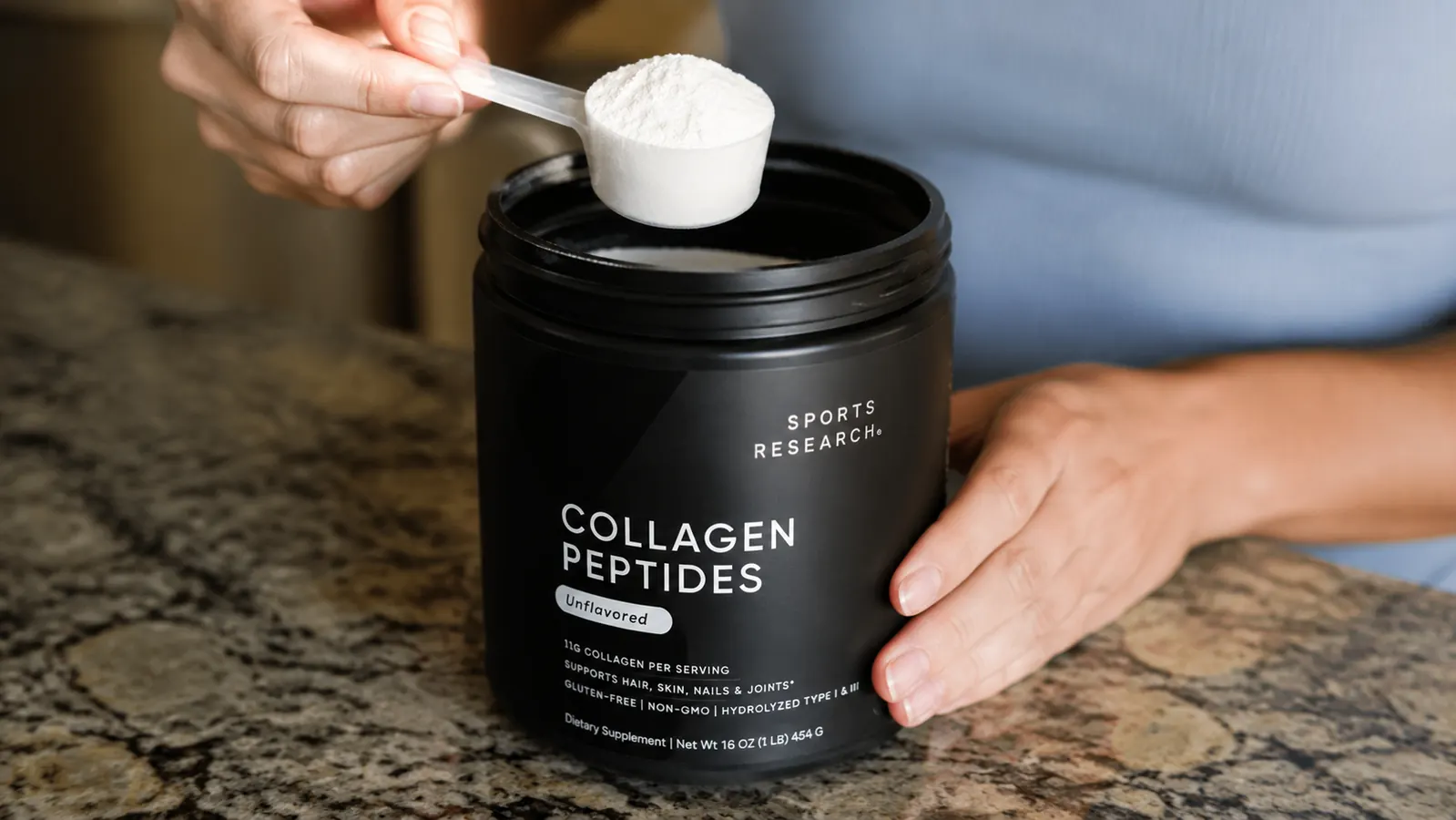
This is the unflavored version, and it genuinely is unflavored. I was burned once before by a different brand's "unflavored" collagen that left a faint chalky aftertaste in my coffee, enough that I stopped using it after three weeks. This one disappears. I can't taste it in coffee, in a protein shake, or in the one time I tried it in oatmeal on a Sunday morning. My wife, who is far pickier about texture than I am, agreed she couldn't tell the difference in her tea either.
Mixability has stayed consistent across all six months and two different tubs. It dissolves fully in hot coffee within a few stirs, no clumping at the bottom of the mug like some of the plant-based protein powders I've used. Cold liquids take a little more effort, a shaker bottle handles it fine, but stirring it into cold water with a spoon leaves small undissolved bits floating on top. I learned early on to either use hot liquid or shake it, not stir it cold.
The powder itself is a fine, almost silky texture, nothing like the gritty feel of some cheaper hydrolyzed collagens I've tried in the past at a friend's suggestion. That consistency hasn't changed between my first tub in January and the one I opened in June, which tells me the manufacturing is dialed in and not something that varies batch to batch.
What Happened With My Knee, Month by Month
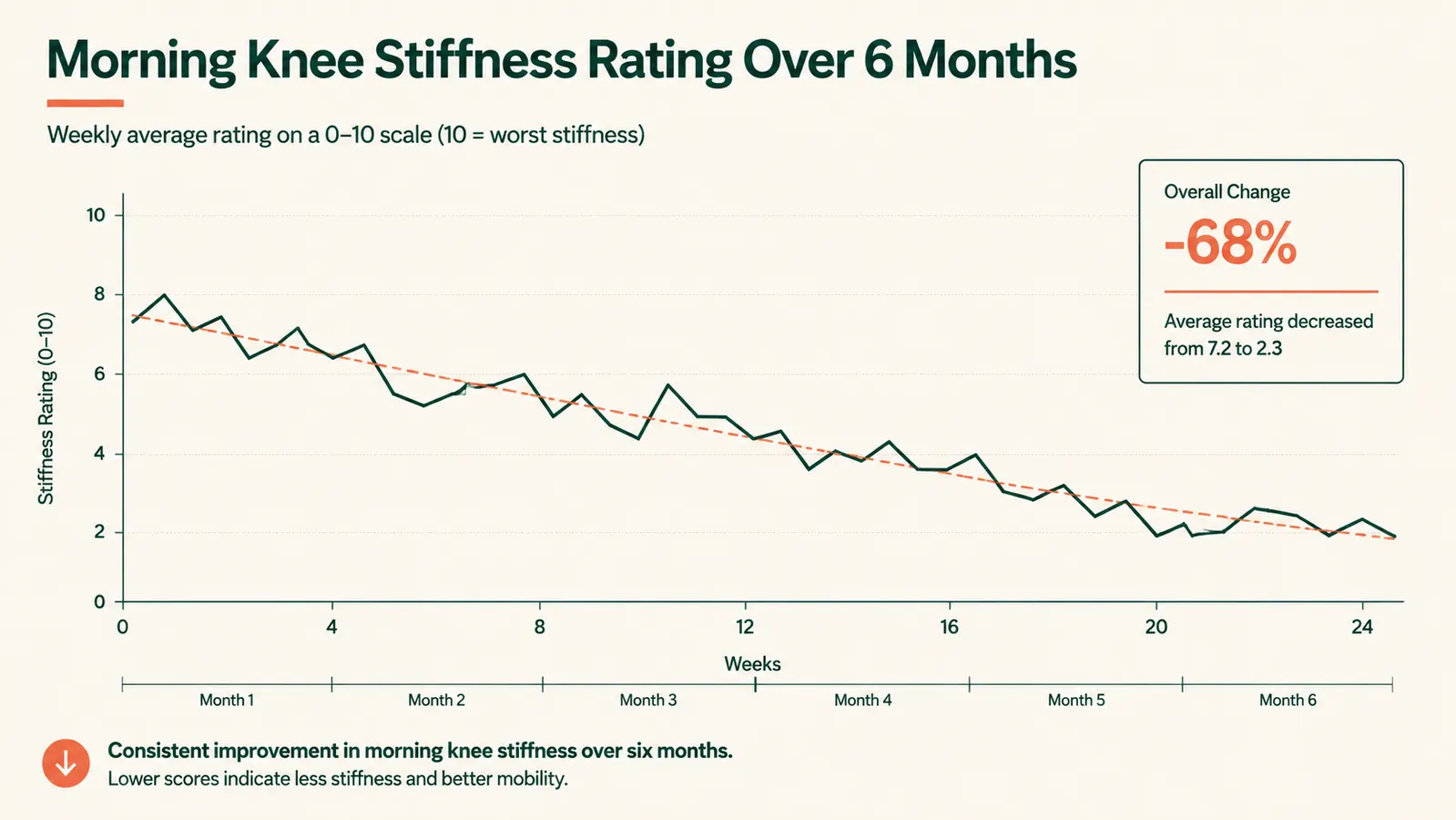
Month one, honestly, nothing. I didn't notice a single difference in how my knee felt in the morning, and I was ready to write this off as another supplement that sounds good on a label and does nothing in practice. I kept going mostly out of stubbornness and because I'd already bought the second tub.
Somewhere around week seven or eight, into month two, I noticed I wasn't doing my usual slow shuffle to the bathroom in the morning. It wasn't dramatic. I just stopped thinking about my knee first thing, which in hindsight was the actual signal, because before that it was one of the first things I noticed every single day. By month three, I could point to specific mornings after heavy squat sessions where the stiffness that used to linger into my commute was gone by the time I'd finished my coffee.
Months four through six have been steady. Not perfect, there are still mornings after a brutal leg day or a long run where I feel it, but the baseline has shifted. I'm not claiming this rebuilt cartilage or reversed twenty years of wear. What I believe happened, based on what little I understand of the research and what I felt in my own body, is that the added collagen gave my joints more raw material to work with during normal repair, and that showed up gradually rather than overnight.
Types I and III Collagen: Why It Matters for Joints and Skin
This product is hydrolyzed types I and III collagen, which are the two types most associated with skin, tendons, and connective tissue rather than the type II collagen you'll see marketed specifically for cartilage. I didn't fully understand this distinction when I bought my first tub. I assumed all collagen supplements worked the same way for joints.
What I've since read, and what lines up loosely with what I felt, is that types I and III seem to do more for tendon and ligament resilience and skin elasticity than for cartilage specifically. My knee issue is more tendon and soft tissue irritation from decades of impact than a cartilage problem, so this may explain why it helped me. If your joint pain is specifically diagnosed cartilage degradation, I'd talk to a doctor about whether a type II collagen or a glucosamine-chondroitin combination might be a better fit than this one. I'm not a doctor and I'm not going to pretend hydrolyzed peptides are a universal fix for every kind of joint pain.
One side effect I didn't expect and wasn't tracking for on purpose: my wife pointed out in March that my hands looked less dry than usual for winter, and I noticed a couple of small cuts on my knuckles from garage work healing faster than they used to. I can't prove that's the collagen and not just a mild winter, but it's consistent enough with what types I and III are supposed to support that I'm noting it here.
Digestion and Any Side Effects
No stomach issues, no bloating, nothing I'd call a side effect across six months of daily use. That matters to me because I've had bad reactions to other powders before, whey protein included, that left me regretting my choice within an hour. This one has never once bothered my stomach, whether I take it on an empty stomach with just coffee or mixed into a post-workout shake with food already in me.
The only thing worth flagging is that it's a bovine-derived collagen, so it's not suitable if you're vegetarian, vegan, or avoid beef products for religious or dietary reasons. That's true of almost every collagen peptide product on the market, not unique to this one, but it's worth knowing before you buy if that matters to you.
I also drink a lot of coffee, two to three cups most mornings, and I was curious whether combining that much caffeine with a daily protein load would upset my stomach the way some pre-workout blends have in the past. It never has. If anything, the collagen seems to sit well precisely because it's not a heavy protein hit the way a full scoop of whey is. I've taken it on empty-stomach fasted mornings before an early run and on full-stomach mornings after a big breakfast, and the result has been the same both ways: nothing.
Value and Tub Life
One tub has lasted me right around six to seven weeks at my two-scoop daily dose, which puts me on roughly my fourth tub since January. At the current price, that works out to a cost that's noticeably lower than what I was spending on the occasional massage or the joint-specific supplement stack I tried the year before, which included three separate bottles and a much bigger daily pill count.
The tub itself has held up fine in my kitchen cabinet, scoop stays clean, lid seals well enough that I've never had a moisture or clumping issue even through a humid stretch of summer. It's not a fancy container, just a plastic tub with a screw lid, but it does the one job it needs to do.
I've also started buying two tubs at a time instead of one, mostly because running out mid-week threw off my morning routine the two times it happened early on. That's a small logistics note, but if you're the type who forgets to reorder until the container is scraping empty, build in a buffer. Missing even four or five days in a row was enough for me to notice the stiffness creeping back in by the time I restocked, which is its own kind of evidence that something real was happening, not just a placebo effect from a new morning habit.
Alternatives I Considered Before Buying
Before landing on this one, I looked at a flavored collagen with added vitamin C that a training partner swears by, and a marine collagen that a physical therapist I used to see recommended for skin elasticity. The flavored option tasted fine in water but clashed badly with coffee, which is my main delivery method most mornings, so that was a quick pass. The marine collagen was noticeably more expensive per serving and had a faint fishy smell straight out of the container that I couldn't get past.
I ended up going with the unflavored bovine version because it disappears into whatever I'm already drinking, the price per serving is reasonable, and the brand had enough of a track record with real reviews that I trusted the sourcing. Six months later, I haven't felt a reason to switch, and I've stopped even looking at the other options when I'm restocking.
What I Liked
- Genuinely flavorless, disappears completely in coffee and shakes
- Zero digestive side effects across six months of daily use
- Noticeable reduction in morning knee stiffness starting around month two
- Dissolves cleanly in hot liquids with no clumping
- Reasonable cost per serving compared to a multi-bottle joint supplement stack
Where It Falls Short
- Results took roughly seven to eight weeks to become noticeable, not fast
- Types I and III are better suited to tendons and skin than cartilage-specific joint issues
- Doesn't dissolve as cleanly in cold water without shaking
- Bovine-derived, not an option if you avoid beef products
By month three, the stiffness that used to linger into my commute was gone by the time I'd finished my coffee.
Who This Is For
Lifters and runners in their 30s, 40s, and 50s dealing with the kind of low-grade joint and tendon stiffness that comes from years of training rather than an acute injury. It's also a solid fit for anyone who wants a flavorless way to add collagen to a routine they already have, coffee, a protein shake, oatmeal, without changing what that routine tastes like. If your joint discomfort is more tendon and connective tissue related than a diagnosed cartilage issue, this is worth a real six to eight week trial, not a two-week judgment.
Who Should Skip It
If you're looking for something that works in days rather than weeks, this isn't it, and I'd be lying if I said otherwise. If your joint pain has been specifically diagnosed as cartilage-related, talk to a doctor about whether a type II collagen product fits your situation better than a type I and III blend. And if you avoid beef products for dietary or religious reasons, this one's off the table regardless, since a marine or vegan collagen alternative would be a better starting point for you.
Six months, still in my coffee every morning.
I don't keep recommending supplements I've quietly stopped taking. This one's still on my counter. See today's price on Amazon before it changes.
Amazon Check Today's Price on Amazon →