
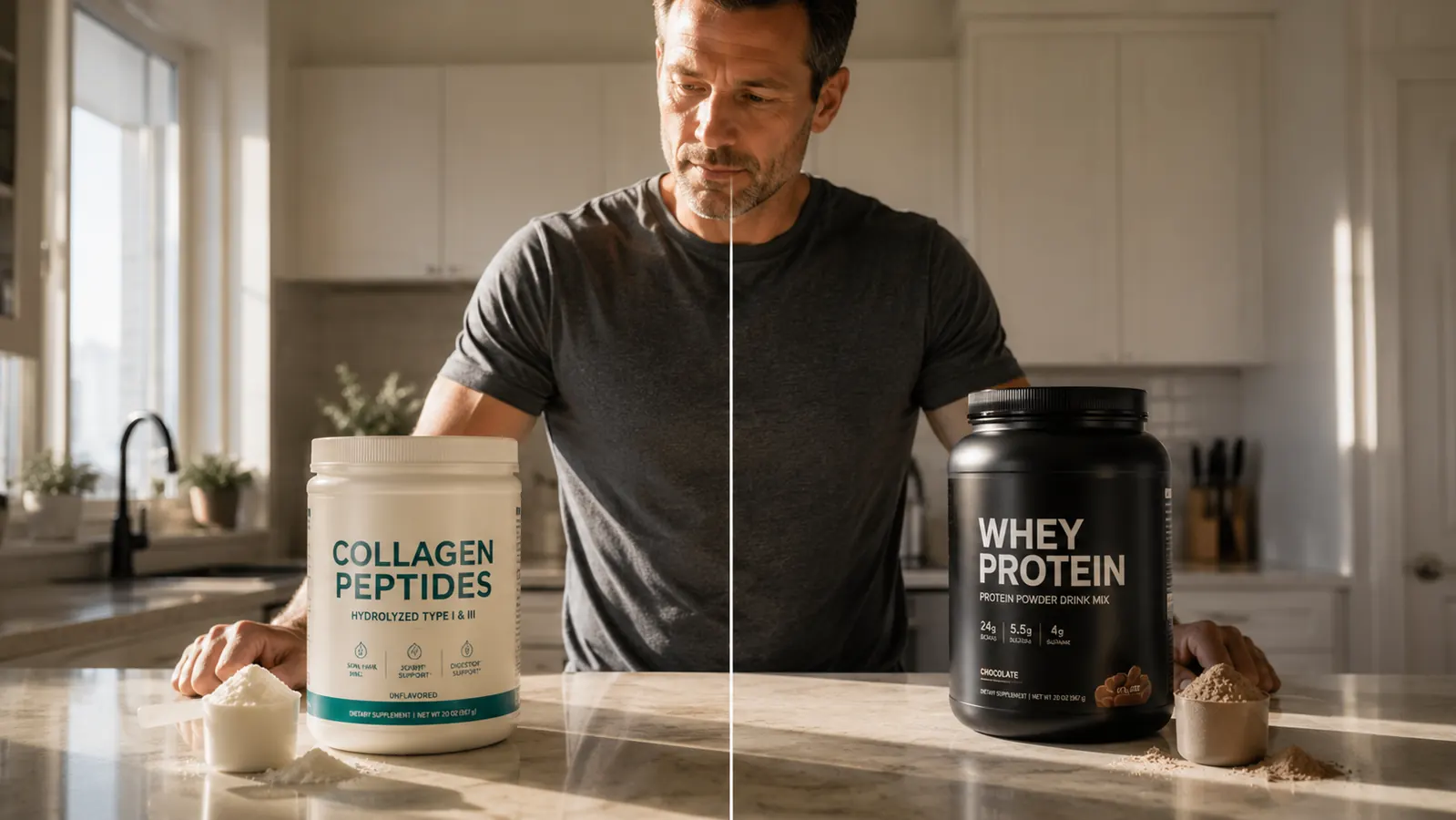
Here's the short answer, because we know you're standing in your kitchen right now trying to decide which scoop goes in the shaker. If what's bothering you is a knee that clicks on the stairs, a stiff lower back, or tendons that feel tight no matter how much you stretch, Sports Research Collagen Peptides is the one we'd reach for. If what's bothering you is that you trained hard yesterday and your muscles are still shredded and you need to rebuild tissue fast, whey protein wins that fight and it isn't close.
We've used both, sometimes on the same day, for years of lifting, running, and the general wear and tear of being active guys in our 40s. They are not competitors. They are not interchangeable. They solve two completely different recovery problems, and most of the confusion out there comes from supplement companies marketing collagen like it's a muscle builder when it was never built for that job in the first place. We wrote this comparison because we were tired of seeing forum threads where someone asks which protein to buy and gets a dozen answers that never mention the one distinction that actually matters, which tissue you're trying to fix.
So before we get into the table, here's the framework we use every time we're deciding which scoop to reach for on a given morning. We ask ourselves one question. Is today's soreness coming from muscle fatigue after a hard session, or is it coming from a joint, tendon, or connective tissue complaint that's been nagging for weeks? Muscle fatigue points toward whey. A joint that's been talking to you since before the workout even started points toward collagen. Most of us need both in the cabinet, we just don't need to overthink which one to grab on a given day once we know what we're actually treating.
| Collagen Peptides | Whey Protein for Recovery | |
|---|---|---|
| Primary amino profile | Glycine, proline, hydroxyproline (connective tissue building blocks) | Leucine, isoleucine, valine (BCAAs, muscle protein synthesis triggers) |
| Target tissue | Tendons, ligaments, cartilage, joint connective tissue, skin | Skeletal muscle fibers |
| Best-use timing | Anytime, once daily, coffee or smoothie, no workout window needed | Within 30 to 60 minutes post-workout for the biggest synthesis response |
| Mixability | Dissolves in hot or cold liquid, no clumping, no shaker needed | Needs a shaker or blender, can clump in plain water |
| Flavor | Unflavored, disappears into coffee, oatmeal, or smoothies | Usually flavored (vanilla, chocolate), noticeable taste on its own |
| Digestion | Very easy on the gut, rarely causes bloating | Can cause bloating or gas in lactose-sensitive users |
| Protein completeness | Incomplete protein, low in tryptophan, not a muscle-building primary source | Complete protein with all essential amino acids |
| Price per serving | Moderate cost per 20g scoop at today's price | Moderate cost per scoop depending on brand |
| Third-party testing | NSF Certified for Sport, Informed Choice certified | Varies widely by brand, check the label |
If it's your joints that are barking, not your muscles, start here.
Sports Research Collagen Peptides is the one we keep in the pantry for the days our knees and lower backs remind us we're not 25 anymore. NSF Certified for Sport, dissolves in coffee without a fight, and it's not trying to be something it's not.
Amazon Check Today's Price on Amazon →Where Collagen Peptides Wins
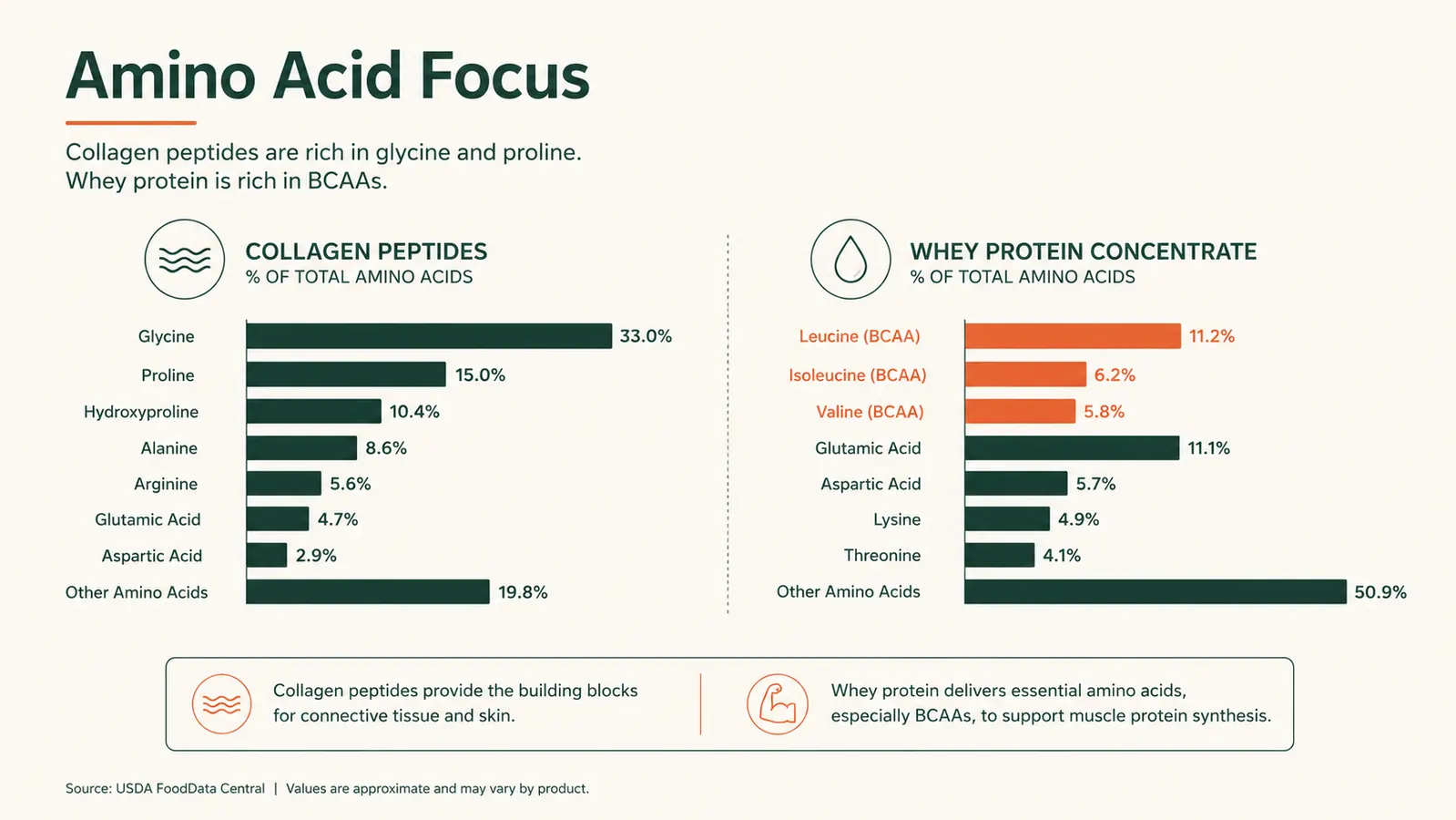
Collagen is the structural protein that makes up your tendons, ligaments, cartilage, and skin. About a third of the amino acids in collagen are glycine, and another big chunk is proline and hydroxyproline, three aminos that show up in barely any amount in a typical whey scoop. Those three are the raw material your body actually uses to repair connective tissue, and that's the whole reason we started taking Sports Research Collagen Peptides in the first place. Rodney's right knee has a mild history of patellar tendinopathy from years of running, and the difference between a week with a morning scoop in his coffee and a week without it is noticeable by day four or five. Less clicking going down stairs, less stiffness getting out of the truck after a long drive, and noticeably less of that dull ache that used to show up around the third mile of an easy run.
There's also real research behind this, not just anecdote. Studies out of Penn State and a few European sports medicine journals have shown that collagen peptides paired with vitamin C about 30 to 60 minutes before loading a joint (think a run, a hike, or a heavy squat session) can measurably boost collagen synthesis in tendons. Vitamin C matters here because it's a cofactor your body needs to actually stitch those amino acids into new collagen fibers, so we usually take our scoop with orange juice or a vitamin C gummy on hard training days instead of just plain water. It's a small detail that a lot of collagen users skip entirely, and skipping it means you're leaving a decent chunk of the benefit on the table.
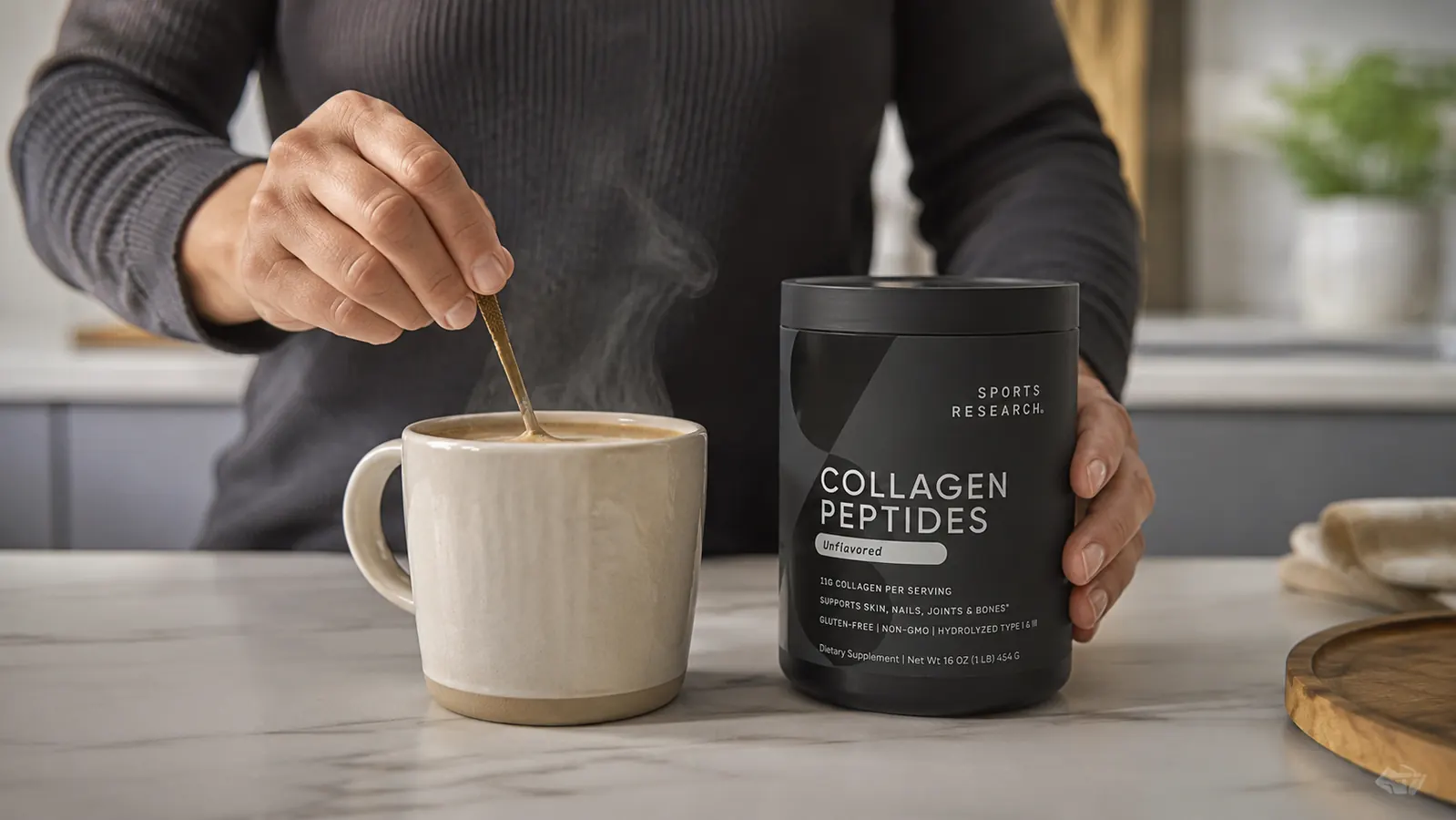
The other underrated win is how easy this stuff is to actually stick with. Sports Research's version is hydrolyzed, meaning the protein chains are already broken down into smaller peptides, so it dissolves completely in hot coffee, iced tea, oatmeal, or a smoothie without turning into a gritty mess at the bottom of the cup. It's unflavored, so it doesn't fight with whatever you're already drinking. That sounds like a small thing until you compare it to trying to choke down a vanilla whey shake at 6am before you've even had breakfast. Compliance beats potency every time, and collagen is simply easier to build into a daily habit that survives busy mornings, travel days, and the general chaos of a normal week.
We've also noticed it plays well with everything else in a recovery stack. It doesn't compete with a post-workout whey shake, it doesn't add extra calories that mess with a cut, and because it's virtually flavorless it doesn't force you to pick a lane between vanilla and chocolate the way most protein powders do. A lot of the guys we've recommended it to started with skin and hair as their only interest and ended up sticking with it for the joints once they noticed their knees felt looser on long runs a few weeks in.
Where Whey Protein Wins
We're not going to pretend collagen can do whey's job, because it can't, and any brand telling you otherwise is selling you something. Whey is a complete protein loaded with all nine essential amino acids, and it's especially rich in leucine, the amino acid that acts like a light switch for muscle protein synthesis. When you tear down muscle fibers during a lifting session or a long run, whey gives your body the exact raw materials and the metabolic signal it needs to rebuild that tissue bigger and stronger. Collagen simply doesn't have enough leucine to trigger that same response, no matter how much of it you drink, and the research on this point is about as settled as sports nutrition research ever gets.
If your recovery goal is muscle, not joints, whey protein within that post-workout window is still the better-studied, more direct tool. It's also just more versatile for people building a full nutrition plan around training volume, since it can realistically serve as a meaningful chunk of daily protein intake in a way collagen, with its incomplete amino profile, was never designed to do. A lot of guys we know run both: whey for the 30-minute post-workout window when muscle repair is the priority, collagen later in the day or first thing in the morning when the goal shifts to joints and connective tissue. That combination covers both bases without asking either supplement to stretch outside its lane.
Whey also has decades of head-to-head research behind it comparing dosing, timing, and total daily protein targets for strength and hypertrophy, which means there's a lot less guesswork involved in using it well. If you're chasing a specific strength or size goal, that body of evidence matters, and it's part of why we'd never tell someone to swap out their post-workout whey for a scoop of collagen and call it even. They're built for different jobs and the research reflects that clearly.
Mistakes We See People Make With Both
The single biggest mistake we see is guys buying collagen expecting it to feel like a pre-workout or a muscle builder, then getting frustrated a month in because their lifts haven't budged. Collagen was never going to move the needle on strength numbers, and judging it by that standard is like judging a foam roller by how much weight it lets you bench. The second most common mistake is the opposite problem, guys who rely on whey alone for years and then wonder why their knees and shoulders start barking around age 40 even though their muscles feel fine. Muscle and connective tissue age on different timelines, and connective tissue is the one that gets neglected because it doesn't show up on a scale or in the mirror the way muscle does.
The other thing worth flagging is dosing. Most of the research showing joint benefits from collagen used somewhere between 10 and 15 grams a day, which lines up with a single scoop of Sports Research's product. Taking less than that inconsistently, like skipping it half the week, is probably why some people try collagen for two weeks and conclude it doesn't work. Give it a full 8 to 12 weeks of daily, consistent use before you decide either way, because connective tissue remodels much slower than muscle does. Whey shows up in a workout log within days. Collagen shows up in how your knees feel on a set of stairs a couple months from now, and that slower timeline trips people up if they're expecting a quick fix.
Collagen shows up in how your knees feel on a set of stairs two months from now, not in tomorrow's workout log. That slower timeline is the whole point.

Who Should Buy Which
If you're dealing with joint stiffness, a nagging tendon, achy knees from running, or you're simply in your late 30s, 40s, or beyond and want to get ahead of the connective tissue breakdown that comes with age and mileage, Sports Research Collagen Peptides is the smarter first buy. It's cheap enough to try at around a dollar a day, it's third-party tested so you know what you're actually getting, and it slides into a coffee habit you already have instead of asking you to build a new one. If your main complaint is muscle soreness after leg day or you're actively trying to add size and strength, put your money into a solid whey protein first and treat collagen as the second thing you add once the joints start talking to you, which for most of us happens sooner than we'd like to admit.
And if you're the type who wants to cover both bases from day one, that's a reasonable call too. Keep a whey shake for the 30 minutes after a hard session and a scoop of collagen in your morning coffee, and you've got a routine that respects what each one is actually good at instead of asking one product to do two jobs it was never designed for. That's the setup we've landed on ourselves after years of trial and error, and it's held up through marathon training blocks, heavy lifting cycles, and the slower stretches where recovery matters more than performance.
Your joints don't get a rest day. Neither should your recovery routine.
We keep a tub of Sports Research Collagen Peptides on the counter year round, not because it's flashy, but because it's the one supplement that quietly does its job every single morning without asking anything extra of us.
Amazon Check Today's Price on Amazon →