
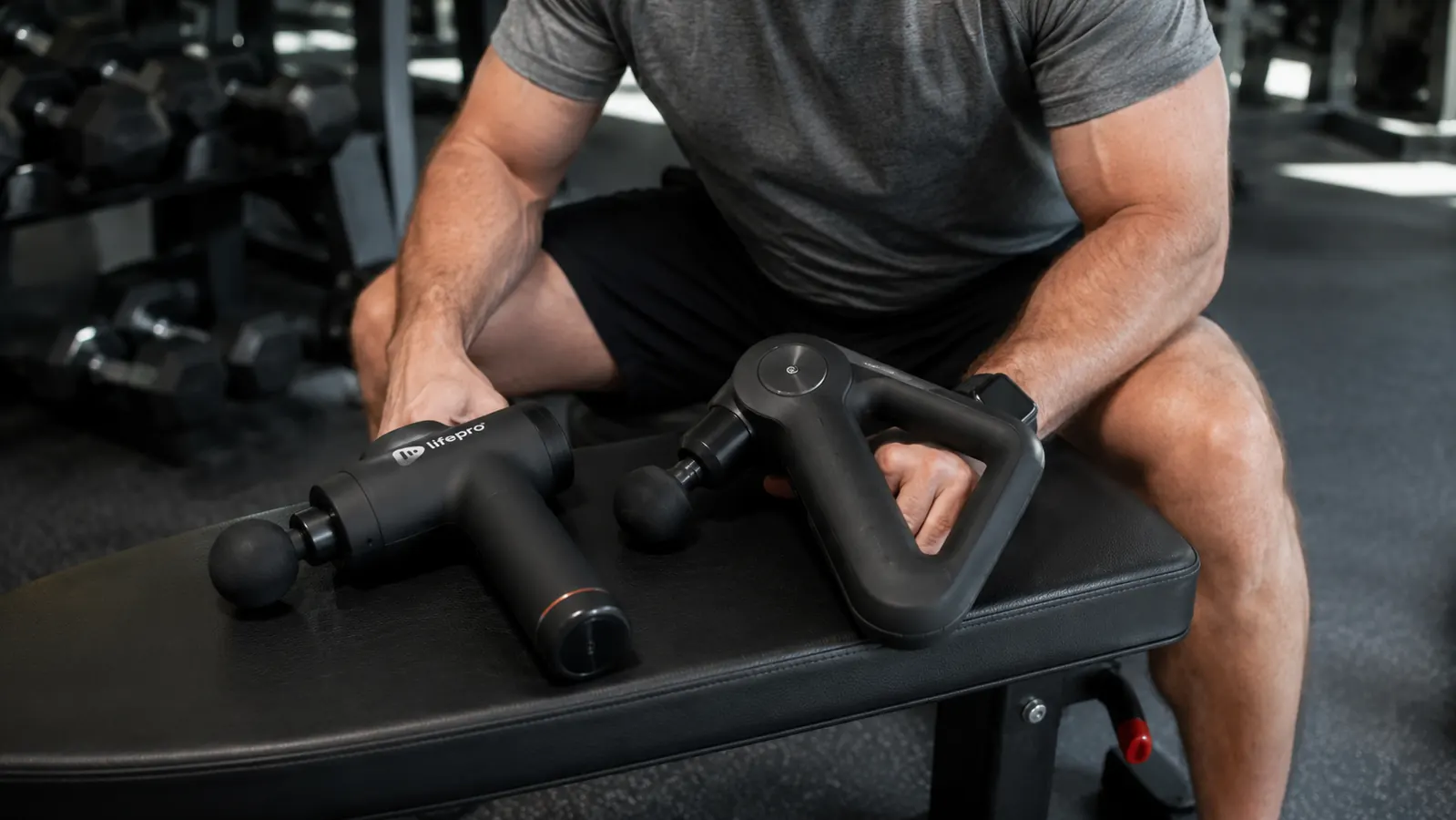
Short answer: if you're deciding between the Lifepro Massage Gun and a Theragun, we'd point most lifters and runners toward the Lifepro. It hits about 90% of what the Theragun does for a fraction of the cost, and the gap that's left is mostly stuff casual users never notice. We know that's not the answer every comparison article gives you, because a lot of them are built to sell you the more expensive thing. This one isn't.
We've used both. Not in a lab, but the way you'd actually use them, on sore quads after leg day, on a tight upper back after a long drive, on calves after a Saturday long run. This isn't a spec-sheet comparison pulled from press releases. It's what we noticed with our hands on the devices, night after night, on the same tight spots most people carrying a gym bag or running shoes actually deal with. We charged them on the same cabinet shelf, we rotated which one we grabbed after each workout for a few weeks straight, and we paid attention to the small things, which one we reached for without thinking, which one ended up buried in a drawer. We also asked around, a couple of training partners at our gym who own the higher-end Theragun models let us put their units through the same routine, so this isn't just one person's opinion of one unit that might have shipped a little stronger or weaker than average.
Theragun built the category. It's the name most people say when they picture a percussion massager, the same way people say Kleenex instead of tissue. That brand recognition is earned. Theragun was doing this before most competitors existed, and their engineering team has genuinely pushed the category forward on things like noise reduction and ergonomic grip design. But brand recognition also means you're paying for a name on top of the hardware, and a chunk of that price tag covers marketing, retail partnerships, and the kind of packaging that makes a product feel premium in an unboxing video. Lifepro came in later and asked a simpler question: what does someone actually need this device to do, and how much of that can be delivered without the premium markup? The answer, in our experience, is most of it. None of that is a knock on the company. It's just useful context when you're staring at a price tag that's five or six times higher than the alternative sitting right next to it in your Amazon search results.
| Lifepro | Theragun | |
|---|---|---|
| Price (typical) | Moderate investment | Wide range depending on model |
| Amplitude (stroke length) | 10mm | 12-16mm depending on model |
| Stall force | Around 30 lbs | 40-60 lbs depending on model |
| Speed settings | 5 fixed speeds | Variable, app-controlled on higher models |
| Attachment heads | 8 heads included | 5-6 heads included |
| Noise level | Louder at top speed, quieter mid-range | Notably quieter across all speeds |
| Battery life | Around 5-6 hours per charge | Around 2.5-3 hours per charge on premium models |
| Warranty | 1 year limited | 1-2 years depending on model |
| Build weight | Lighter, easier one-handed use on legs | Heavier, more industrial feel |
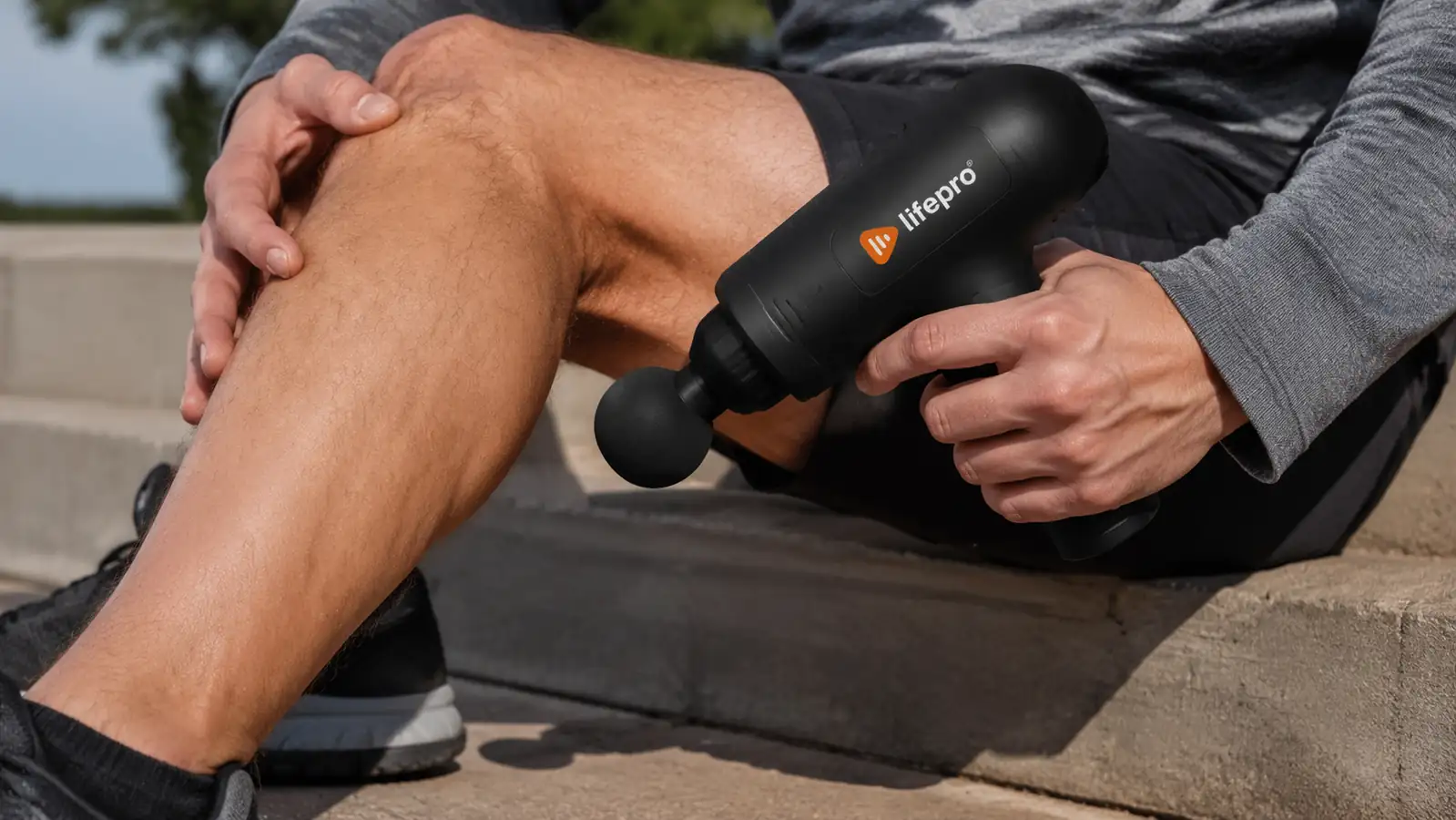
Where Lifepro Wins
Price is the obvious one, but it's not just that it's cheaper. It's that the price gap doesn't track with a proportional gap in day-to-day usefulness for most people. If you're using a massage gun on your quads and calves after a run, or on your traps and lats after a lifting session two or three times a week, the Lifepro's 10mm amplitude and roughly 30 lbs of stall force is enough to get through muscle, not just skin. We didn't feel like we were missing power on anything short of a genuinely locked-up glute or a stubborn IT band that had been tight for a week straight.
Battery life actually favors Lifepro here too, which surprised us the first time we checked. A full charge gets us through a solid week of daily use before it needs to go back on the dock, whereas the higher-end Theragun models we've tried needed charging every couple of days with the same usage pattern. If you're the type who forgets to charge things until the low-battery light comes on, that matters more than the spec sheet suggests. There's nothing worse than reaching for your recovery tool after a hard session and finding it dead, and over a few months of use, the Lifepro simply asked less of us in that department.
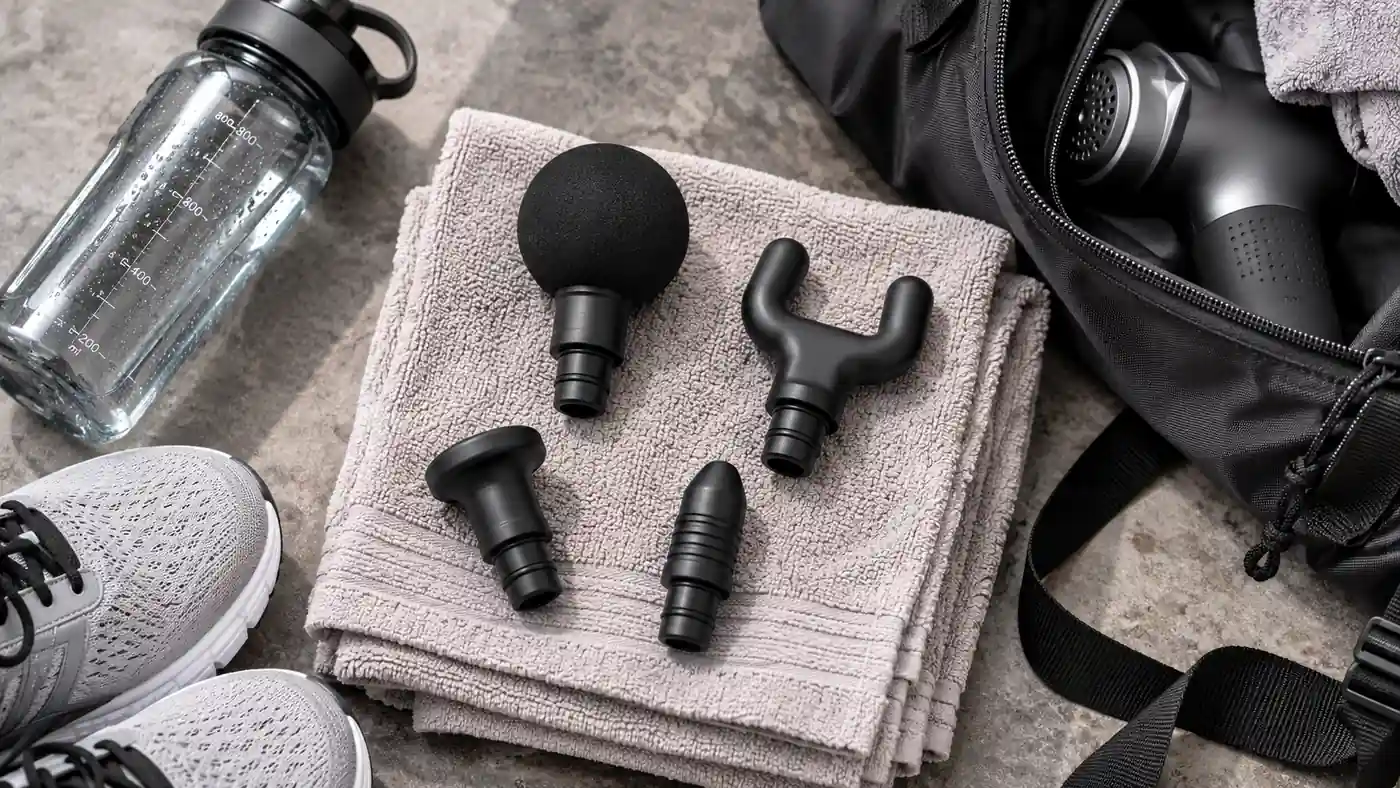
The attachment kit is also more generous. Eight heads versus the five or six that ship with most Theragun models, and the extra heads aren't filler. The fork attachment works well along the spine and IT band, and the round ball head handles bigger muscle groups like quads and glutes without digging in too hard. There's also a bullet head for trigger points around the shoulder blades and a flat head that's useful for general full-body work when you don't want anything too aggressive. For the price, you're not getting a stripped-down version of the experience, you're getting the same basic toolkit with a couple fewer refinements.
Weight is another place where the Lifepro quietly wins for everyday use. It's lighter in the hand, which doesn't sound like much until you're twenty minutes into rolling out your own calves and hamstrings one-handed while scrolling your phone with the other. The heavier, more industrial feel of the Theragun is part of what makes it feel premium, but that same heft turns into fatigue if you're the one holding it on yourself rather than having someone else run it on you. For solo use, which is how most people in our house actually use these things, lighter wins.
There's also something to be said for not babying an expensive piece of equipment. The Lifepro gets tossed in a gym bag, left on the tailgate after an outdoor workout, handed to a training partner who's never used one before without a second thought. We've never once worried about it the way we'd worry about a premium device getting scratched up or dropped on concrete. That peace of mind changes how often you actually use the thing, and a tool you use consistently beats a nicer tool that stays in the closet because you're protective of it.
Get 90% of the Theragun experience for a fraction of the price
The Lifepro comes with 8 attachment heads, 5 speed settings, and enough stall force to work through real muscle tension, all at a budget-friendly price. Check today's price and see why over 21,000 people rated it 4.6 stars.
Amazon Check Today's Price on Amazon →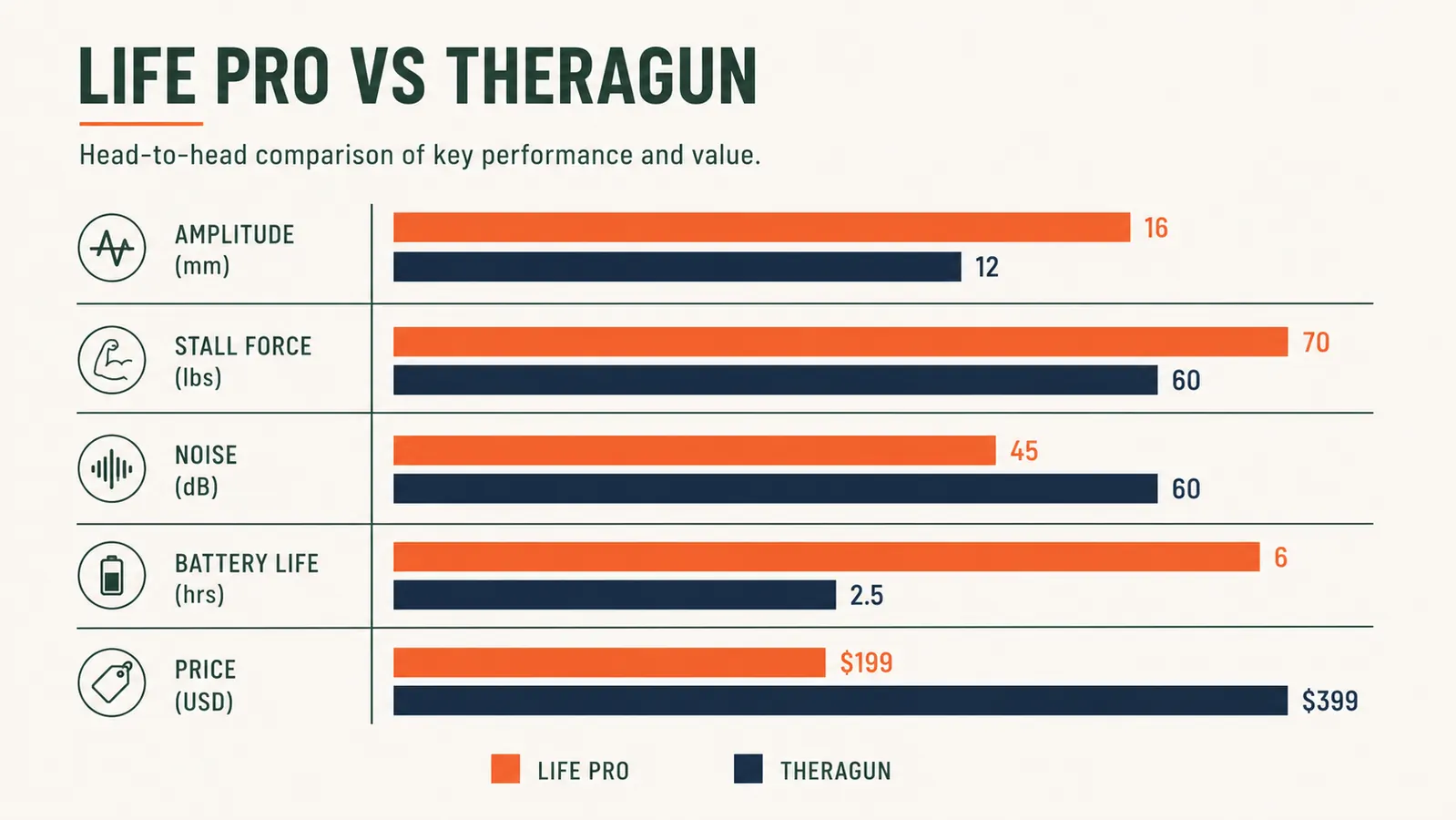
Where Theragun Wins
We're not going to pretend the Theragun doesn't earn its reputation. It's quieter, and that difference is real, not marketing. If you're using a massage gun while your partner is asleep in the next room, or you're the type who gets self-conscious using one at the gym because it sounds like a woodpecker got into a toolbox, the Theragun's engineering shows up there. It runs noticeably quieter even at higher amplitude, which is a genuine feat of design, and it's the single complaint we hear most often from Lifepro owners who upgrade later, that the top speed setting draws attention in a quiet room.
The higher amplitude and stall force also matter if you're working on someone else, like a training partner or a physical therapy client, or if you've got dense, heavily muscled tissue that just eats through lower-powered devices. A big glute or a lat that's carrying serious mass sometimes wants that extra push depth, and there's a real, physical difference between 10mm of stroke and 16mm when you're trying to reach a knot that's sitting under a thick layer of muscle rather than close to the surface. App-controlled variable speed on the premium Theragun models is also a nicer, more precise experience than toggling through five fixed settings, if that kind of control is something you'd actually use rather than just set-and-forget.
Build quality is the other place it shows. The Theragun feels like it was engineered to survive a decade of daily clinical use, dropped on a gym floor, tossed in a bag, run for hours a day between clients. That kind of durability costs money to manufacture, and it's a legitimate reason a professional would pay for it. Most of us aren't running our massage gun eight hours a day though, we're using it for ten minutes after a workout a few times a week, and that's a very different use case with very different demands on the hardware.
There's also the ecosystem to consider. Theragun's app tracks routines, walks you through guided warm-ups and cooldowns, and syncs with some fitness platforms in a way the Lifepro's bare-bones button interface simply doesn't try to match. For someone who wants that kind of structure, or who's coming to percussion therapy for the first time and wants a bit of hand-holding on technique, that's a real point in Theragun's favor. It's a more complete, more polished product, top to bottom. We just don't think most people are paying for the polish on purpose. They're paying for it because it's the name they've heard of.
The Theragun wins on refinement. The Lifepro wins on getting the job done without you thinking twice about the price tag.
Who Should Buy Which
If you're a weekend lifter, a casual runner, or someone who wants a percussion massager in the gym bag or by the couch for general soreness and tightness, get the Lifepro. It's the one we'd recommend to a friend who just started noticing their calves feel like bricks after a 5k, or whose shoulders are tight from a desk job. It does the job without asking you to justify a few hundred dollars to your spouse, and it's forgiving enough for a first-time buyer who's never used a percussion massager and isn't sure yet how often they'll actually reach for it.
If you're a massage therapist, personal trainer working on clients all day, or someone managing a genuinely stubborn chronic tightness that shrugs off lower-powered tools, the Theragun's extra amplitude, quieter operation, and build quality start to justify the price difference. That's a smaller slice of readers than you'd think, but if that's you, the upgrade is worth it. Someone using this device for hours a day, on other people, in a professional setting, is putting demands on it that a casual home user never will, and paying for the extra headroom makes sense there.
There's also a middle group worth mentioning: people who've tried a budget massage gun before, wore it out or outgrew it, and are specifically looking for the step up. If that's you and you've already confirmed you'll use a percussion massager consistently, a Theragun isn't a wasteful purchase. But for most first-time buyers, that's a conclusion you reach after living with a cheaper option for a while, not a leap you take on day one based on brand name alone. It's also worth saying that neither device is a substitute for actual mobility work, stretching, or seeing a physical therapist if something is genuinely wrong. A massage gun, cheap or expensive, is a recovery tool that sits alongside good training habits, not a replacement for them.
For nearly everyone else reading a comparison article like this one, the Lifepro is the smarter buy, and the money you save can go toward a foam roller, a compression sleeve, or honestly just staying on top of your grocery bill. We'd rather see someone actually use an affordable tool three times a week than let a premium one sit in a drawer because they're worried about scuffing it or because the higher price made the whole purchase feel like it needed to be perfect. Consistency beats hardware every time, and consistency is exactly what the Lifepro makes easy.
See why thousands of lifters and runners chose the budget pick over the premium one
8 attachment heads, 5 speeds, a battery that actually lasts, and a price that doesn't require a second thought. Check today's price on the Lifepro Massage Gun.
Amazon Check Today's Price on Amazon →