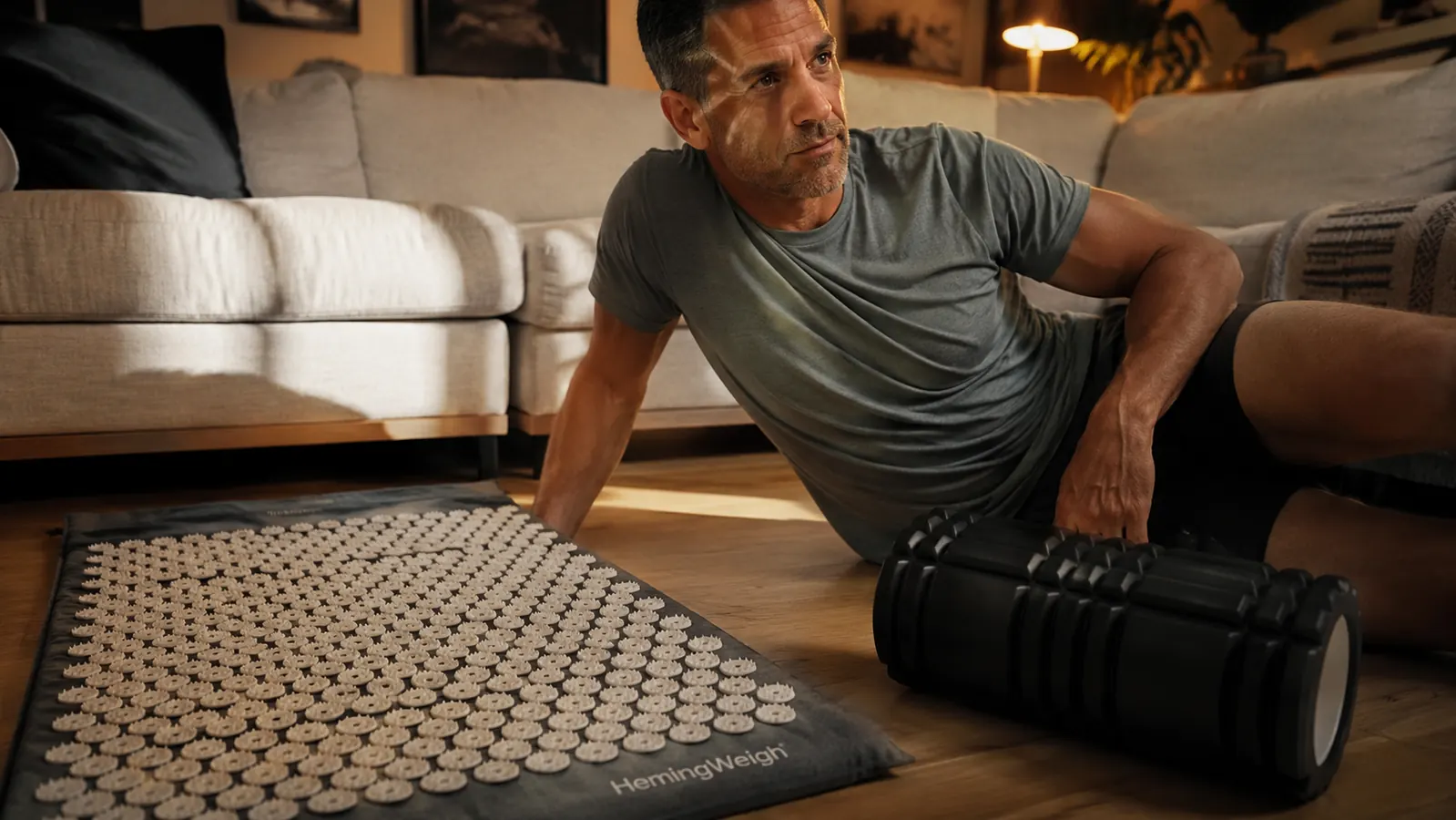
Short answer: if what you're dealing with is broad, generalized tension across your back, shoulders, and neck, especially the kind that builds up over a long day of sitting or standing, we'd point you toward the acupressure mat. If what you're dealing with is a specific, localized knot in a muscle, like a hot spot in your quad after leg day or a tight IT band after a long run, the foam roller is still the better tool for that job. They're not really competing for the same task, even though they get lumped together as "recovery tools you lie on the floor with."
We've used both for years, not back to back in a lab setting, but the way you'd actually use them at home. The HemingWeigh mat lives by the couch and comes out most nights after dinner. A foam roller has lived in the corner of the garage gym for longer than we can remember, and it gets pulled out before or after a lifting session a few times a week. This comparison is built on that real, repeated use, not a spec sheet pulled from a product listing. We tracked how often we actually reached for each one over a month, not how often we intended to, and the pattern that showed up surprised us a little.
The core difference comes down to mechanism. An acupressure mat is a flat surface covered in hundreds or thousands of small plastic spikes, and you lie your body weight directly on top of it. It's a static, passive tool, you don't move it, you let it press into you. A foam roller works the opposite way. It's a cylinder you actively roll your body across, using your own muscle control to apply and adjust pressure along a specific line of tissue. One is something you lie on and let happen to you. The other is something you actively do to yourself. That distinction matters more than it sounds like it should, and it's the thread that runs through almost every difference below, from how much energy each one demands to what time of day you'd actually reach for it.
| Acupressure Mat | Foam Roller | |
|---|---|---|
| Mechanism | Static field of spikes, passive full-body contact | Rolling cylindrical pressure, active and directed |
| Target area | Broad surface, entire back, shoulders, and neck at once | Targeted trigger points, one muscle group at a time |
| Effort required | Passive, just lie down and stay still | Active, requires body weight shifting and control |
| Learning curve | Almost none, lie down and breathe | Moderate, technique affects how effective it is |
| Best for | General tension, stress relief, evening wind-down | Localized knots, pre-workout activation, myofascial release |
| Portability | Rolls up small, includes carry bag | Bulky cylinder, harder to pack for travel |
| Typical price | Affordable | Budget to mid-range depending on density and size |
| Relaxation and sleep benefit | Strong, commonly used as a bedtime wind-down ritual | Minimal, more of a pre or post-training tool |
| Sensation | Sharp initial pinprick that fades into warmth and tingling | Deep, direct pressure that can be sharply painful on tight spots |
Where the Acupressure Mat Wins
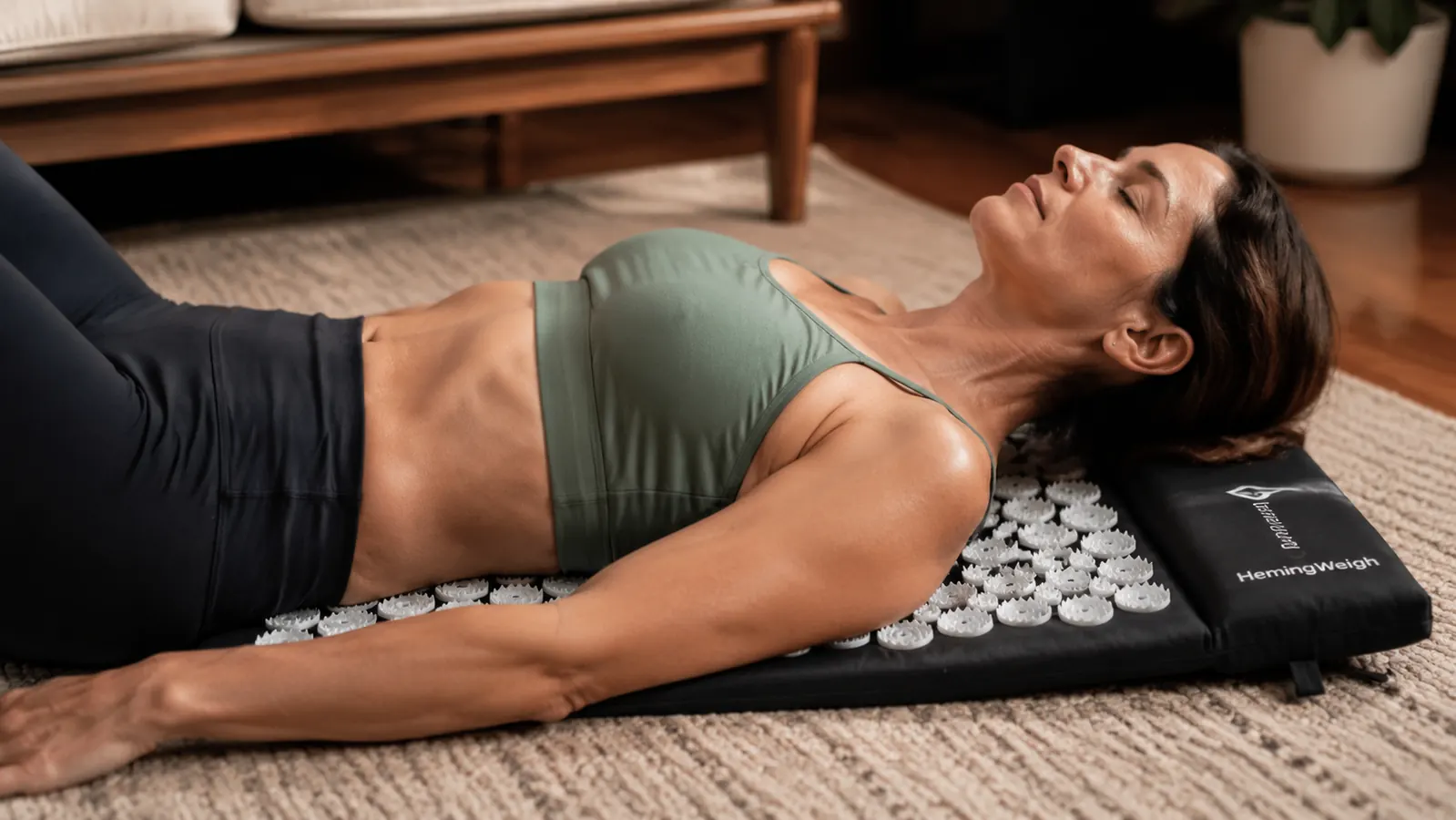
The biggest advantage the mat has is coverage. When you lie back on the HemingWeigh mat, your entire upper back, both shoulders, and your neck if you position it right, are all being worked at the same time. A foam roller can only address whatever narrow strip of tissue is directly under your body weight in that moment, which means you're constantly repositioning to hit different areas. If your tension isn't localized to one specific spot, if it's more of a general tightness that's crept across your whole upper back from a long week of hunching over a laptop, the mat's broad, even coverage does something the roller structurally can't. You're not chasing the tight spot around your shoulder blade, you're just letting the whole area get worked at once.
The second advantage is effort, or really the lack of it. You don't have to do anything on the mat except lie down and let your own body weight do the work. That sounds like a small thing until you're the person who's supposed to be recovering but is too wiped out at the end of the day to actively roll anything. We've had nights where the idea of getting on the floor and working a foam roller across our quads felt like one more chore on top of an already long day, but lying flat on the mat for fifteen minutes while scrolling on the couch or half-watching TV never felt like effort. That difference in required energy is a real factor in whether a recovery habit actually sticks, and it's probably the single biggest reason the mat has outlasted a handful of other recovery gadgets we've bought and quietly stopped using.
The mat also does something the roller was never really built to do well, which is help you wind down before bed. The sensation starts sharp, hundreds of small points pressing into your skin, but within a few minutes your body starts releasing tension and the feeling shifts into a warm, almost tingling relaxation. That's a nervous-system response, not just a muscular one, and it's the reason people use the mat as part of a bedtime routine rather than a pre-workout one. A foam roller, by contrast, tends to leave you feeling activated and a little sore in the moment, which is exactly what you want before a lift, and exactly what you don't want twenty minutes before trying to fall asleep. We've genuinely fallen half asleep on the mat during a fifteen-minute session, which has never once happened mid-roll on the roller.
There's also a low-friction factor that matters more than people expect. The mat rolls up into a bag and stores flat behind the couch, so it's never in the way and there's no setup involved beyond unrolling it on the floor. That means the barrier between "I should probably work on this tension" and actually doing something about it is close to zero. A lot of recovery tools fail not because they don't work, but because they're annoying enough to set up that people stop bothering after a couple of weeks. The mat mostly avoids that trap.
For broad back and shoulder tension, the mat does what a roller structurally can't
The HemingWeigh acupressure mat covers your entire upper back and shoulders at once, with zero effort beyond lying down. Check today's price and see why it's become a nightly ritual for thousands of desk workers and weekend athletes.
Amazon Check Today's Price on Amazon →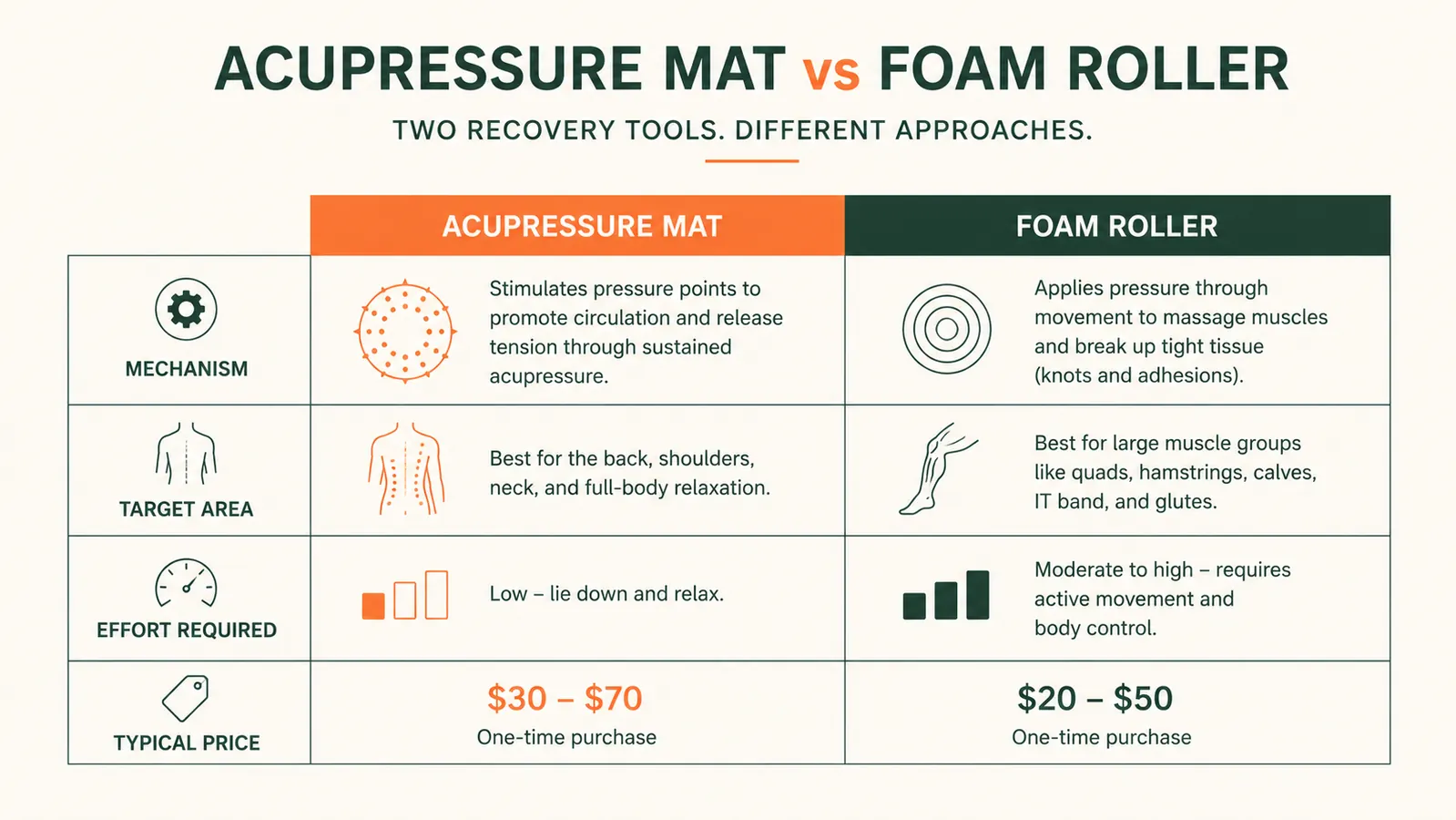
Where the Foam Roller Wins
We're not going to pretend the mat replaces the roller, because for a specific, localized knot it doesn't come close. If you've got a tight spot in your calf, a stubborn trigger point in your glute, or an IT band that's been barking at you for a week, the roller lets you apply direct, controllable pressure to that exact spot and hold it there, or work it back and forth until it releases. The mat's spikes are spread across a wide surface, which is exactly why it's good for broad tension, but it also means it can't concentrate pressure on one square inch the way a roller edge can when you shift your weight into it. When we're chasing one specific knot, the roller finds it in a way the mat simply isn't built to.
The roller also earns its place before a workout in a way the mat doesn't. Rolling out your quads, hamstrings, or lats before lifting or running is a common part of an active warm-up, it increases blood flow to the tissue and can improve range of motion right before you need it. Nobody straps into a lifting session after fifteen minutes lying still on an acupressure mat, that's not what it's for. If your routine includes a pre-training mobility sequence, the roller is doing a job the mat was never designed to do, and swapping one for the other in that context just doesn't work.
There's also a control factor that matters for people managing a specific injury or chronic tight spot under guidance from a physical therapist. With a roller, you decide exactly how much pressure to apply by how much body weight you shift onto it, and you can back off instantly if something feels wrong. With the mat, once you're lying on it, the pressure across your whole back is fairly fixed by your own weight distribution, which is less precise if you're trying to avoid a specific area or manage a very localized issue like a pinched nerve near the shoulder blade.
The roller is also just more versatile across the rest of the body. You can work your calves, hamstrings, quads, lats, and even the outside of your hip with the same tool, just by repositioning. The mat is really built for the back, shoulders, neck, and feet if you stand on it, and it doesn't translate well to rolling out a tight hamstring after a long run. If your soreness moves around your body depending on what you trained that week, the roller's flexibility is a real advantage the mat can't match.
The roller wins when the problem is one specific knot. The mat wins when the problem is your whole back after a long day and you just want to lie down and let it go.
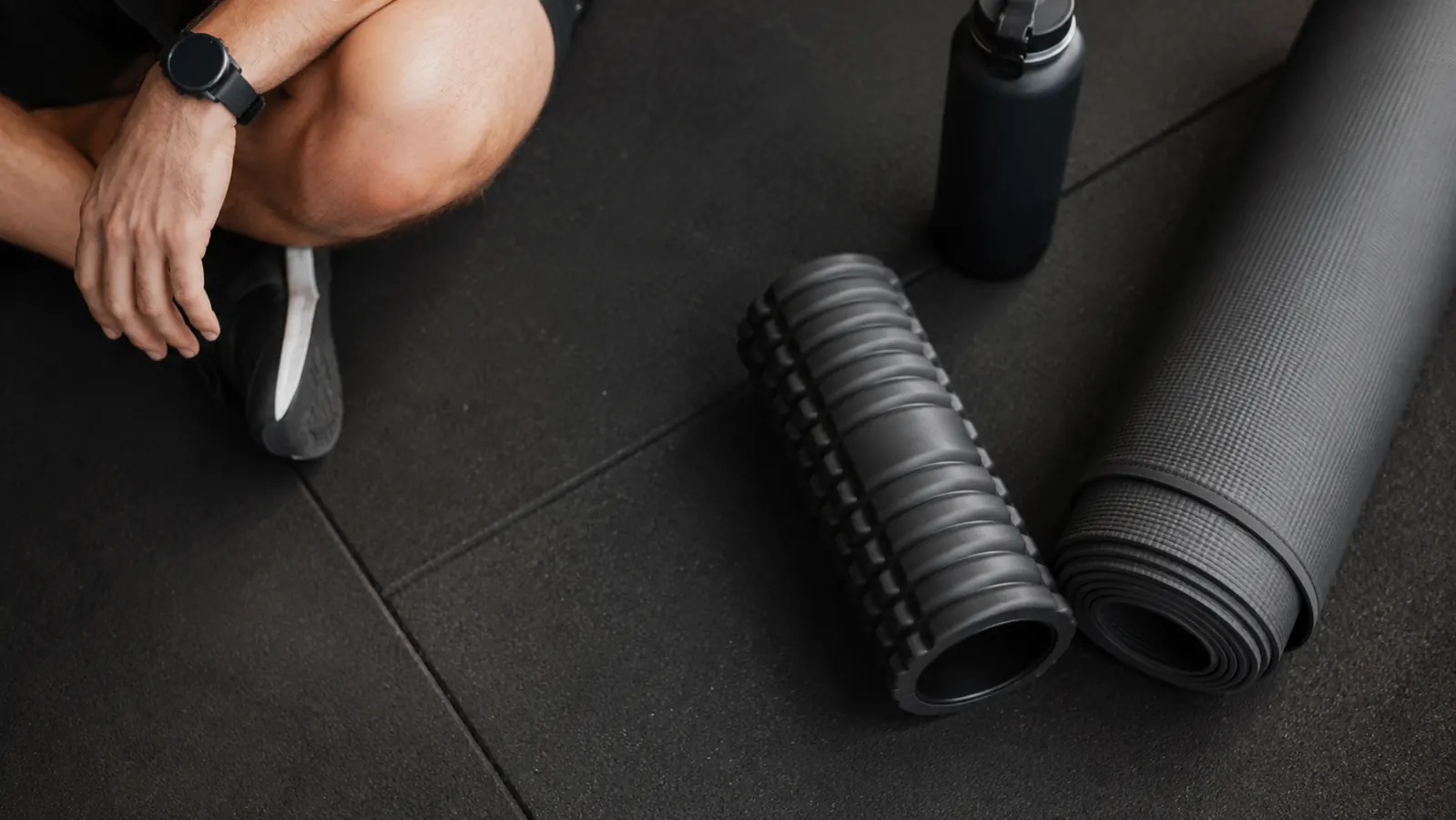
Who Should Buy Which
If most of your tension shows up as a general tightness across your shoulders and upper back, the kind that builds from sitting at a desk all day or standing on your feet for a long shift, and you want something you can use every single evening without it feeling like another workout, get the acupressure mat. It's the one we'd recommend to a friend who says their shoulders feel like concrete by 6pm and they can't fall asleep because of it. For a modest investment it becomes a nightly ritual, not a chore, and that consistency is what actually produces results over weeks and months. It's also a smart pick for anyone who's tried a foam roller before and abandoned it because it felt like too much effort at the end of a long day.
If your issue is more specific, a tight IT band, sore quads after leg day, a knot in your upper trap that a broad-contact tool just can't zero in on, keep the foam roller in rotation, or add one if you don't already own one. It's also the better choice if you want an active pre-workout warm-up tool rather than a passive wind-down one. Honestly, plenty of people we know end up owning both, because they're solving two different problems. The roller handles the sharp, localized stuff before and after training. The mat handles the broad, end-of-day tension that has nowhere specific to point to. If you only have room in the budget for one right now, and your bigger complaint is general tightness and poor sleep rather than one specific muscle knot, the mat is the smarter first purchase, and it's cheap enough that adding a roller later isn't a big decision either way.
Fifteen minutes a night, zero effort, and your whole back gets worked at once
No rolling, no positioning, no active effort. Just lie back and let the HemingWeigh acupressure mat do the work while you unwind. Check today's price and see current ratings from over 1,500 buyers.
Amazon Check Today's Price on Amazon →